Ghiaia Nera
Karakoram, in Turkic, means "black gravel."
A hard, stern sound that immediately evokes harsh and inhospitable landscapes. Central Asian merchants used this evocative name for the Karakoram Pass, a mountain crossing at 5,540 metres between Pakistan and China.
For millennia, this pass was a crossroads of traders and pilgrims, Buddhist monks and explorers following the legendary Silk Road, the trade route connecting East and West.
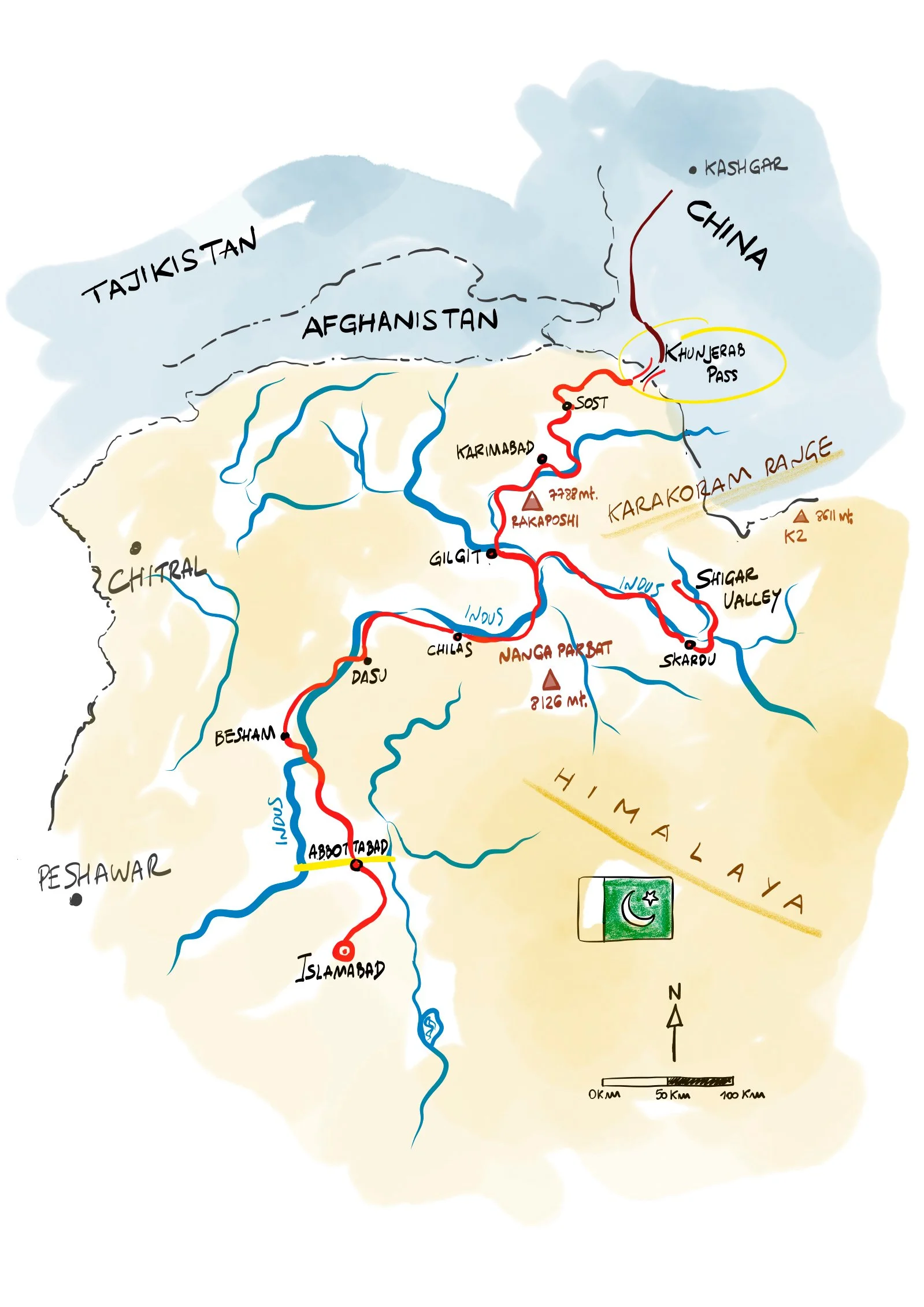
Today, alongside what remains of those rugged ancient trails, runs the modern Karakoram Highway — an asphalt road built in the 1960s and 70s, an engineering feat linking the Pakistani capital of Islamabad with the Chinese town of Kashgar. From the Khunjerab Pass, on the Chinese border, it slides southwards, curling and stretching through territories of mythical scale, almost chasing the course of the Indus River flowing below — at times placid, at times violent.
Along this road, together with two friends, I began my journey on the Silk Road. A tiny stretch, compared to its whole.
After meeting in Lahore, we reached Abbottabad, our starting point for the ascent of the Karakoram Highway towards the Sino-Pakistani border. The goal was to stand face to face with the Chinese border gate at the Khunjerab Pass, then turn back and descend south.
What drew me was the idea of meeting those who still live in these places worn down by history — hoping to find answers to the many fragile questions I carried in my head.
A photographic reportage along the Karakoram Highway — Pakistan, 2023
-
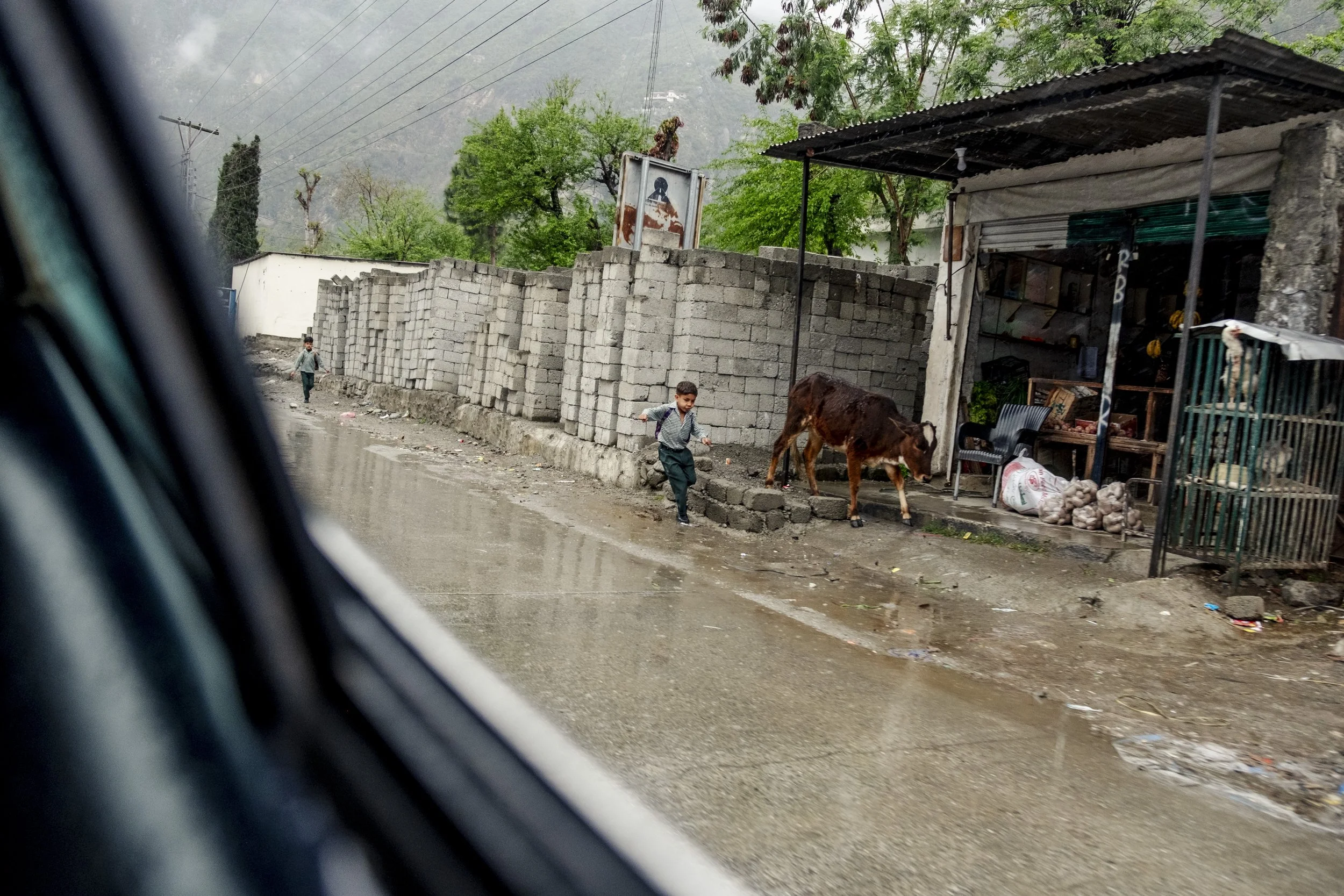
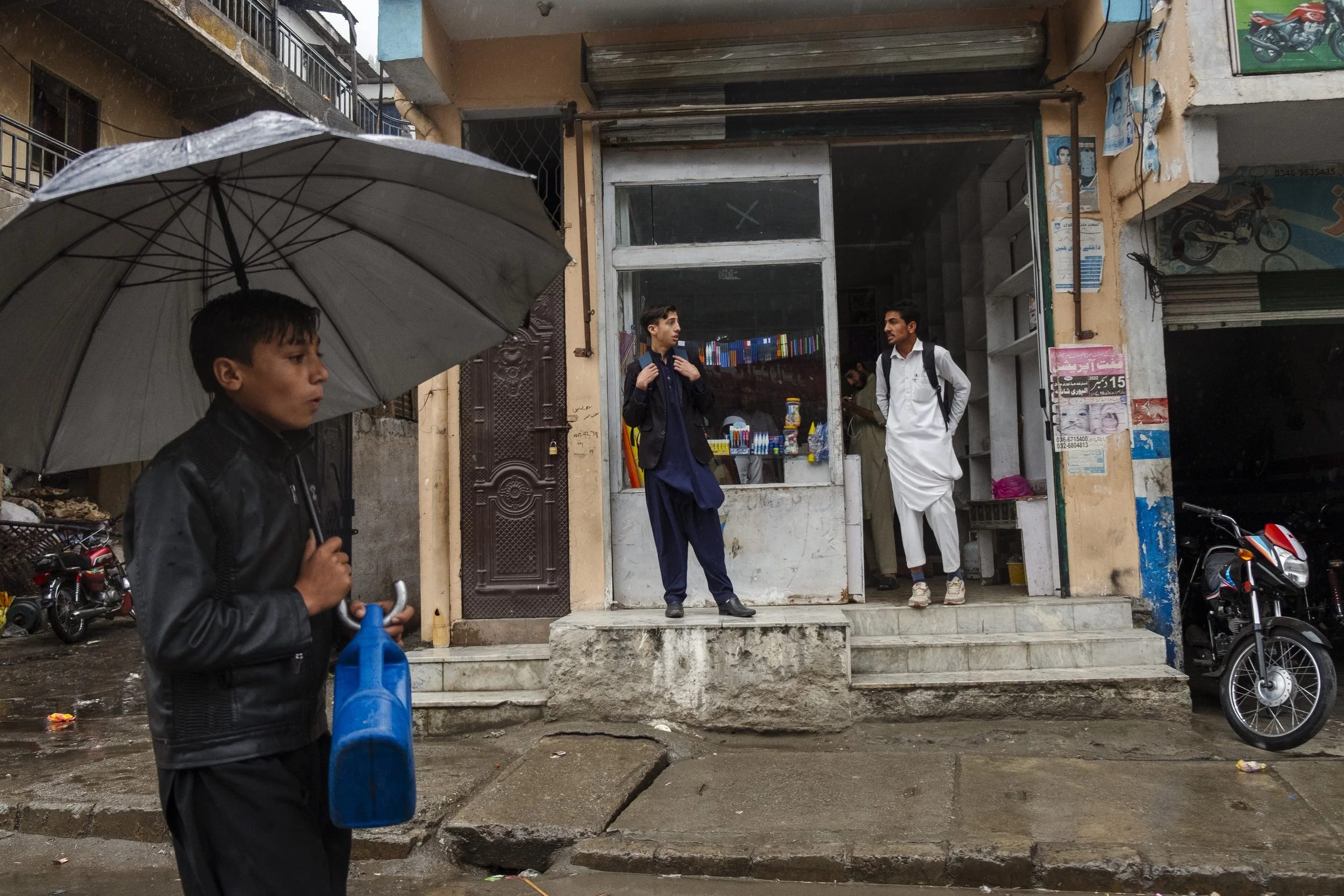
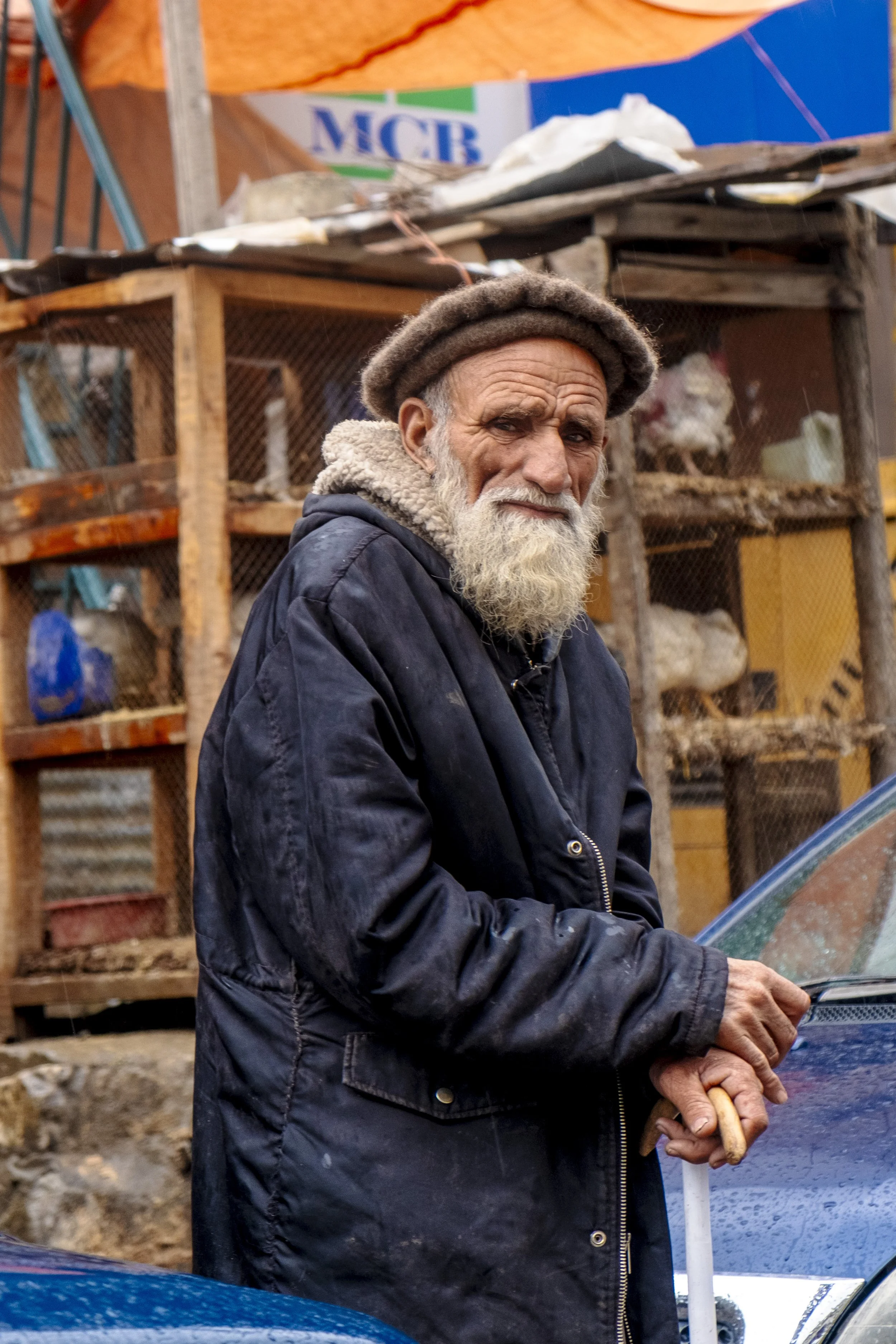
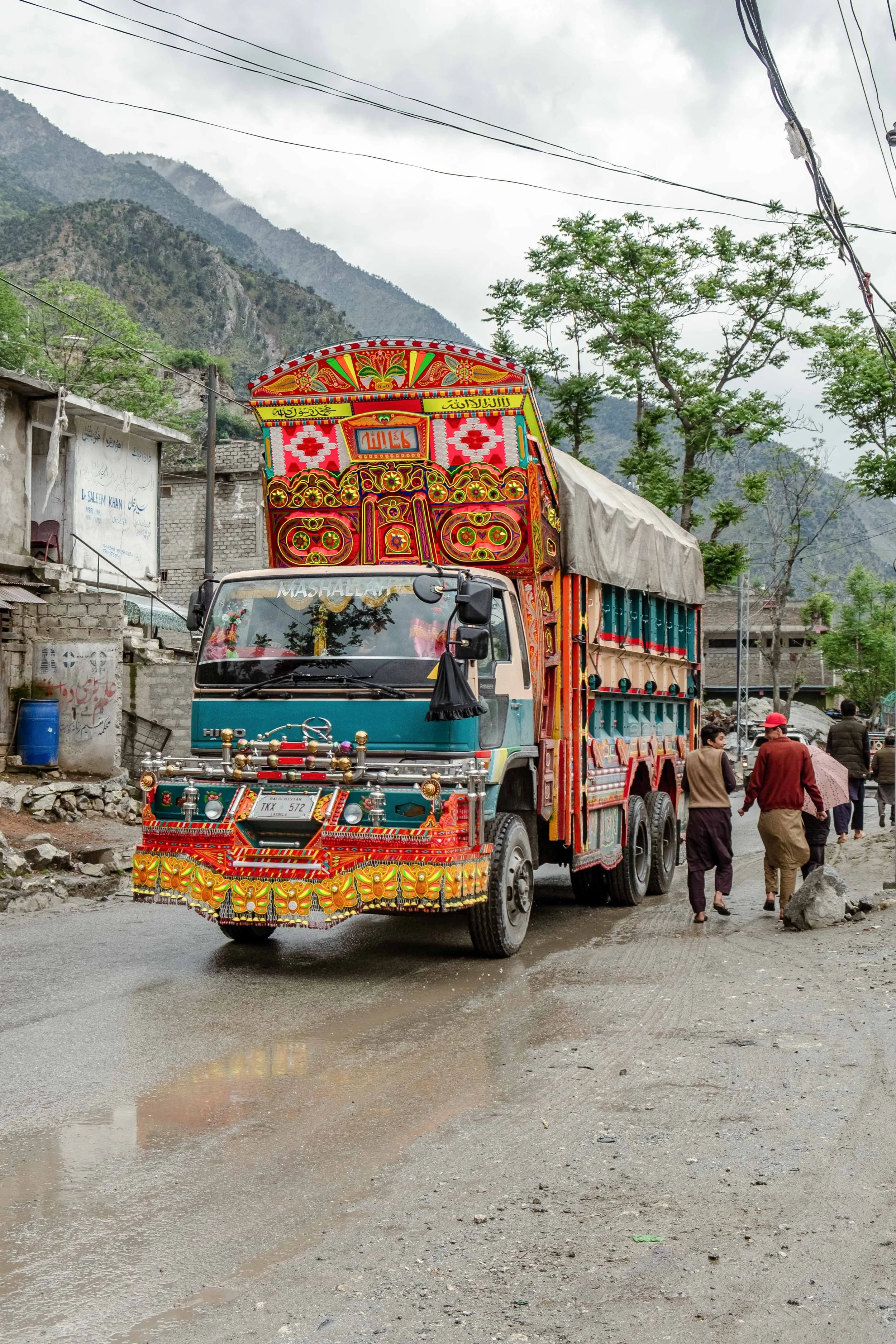
The old man. Traffic on the "Silk Road." Trucks and sputtering motorbikes, crawling at a snail's pace for nearly an hour — stuck in the middle of nowhere.
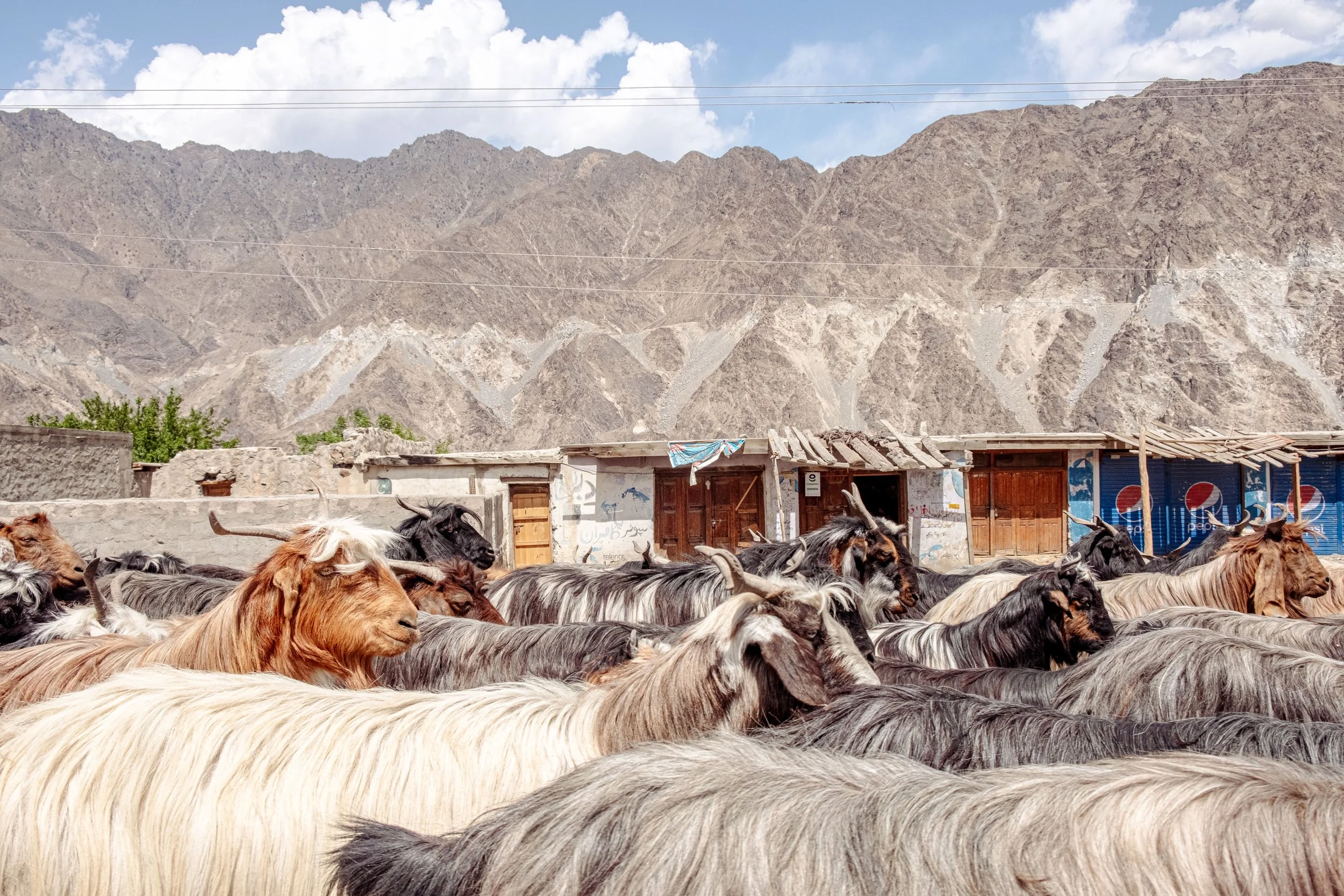
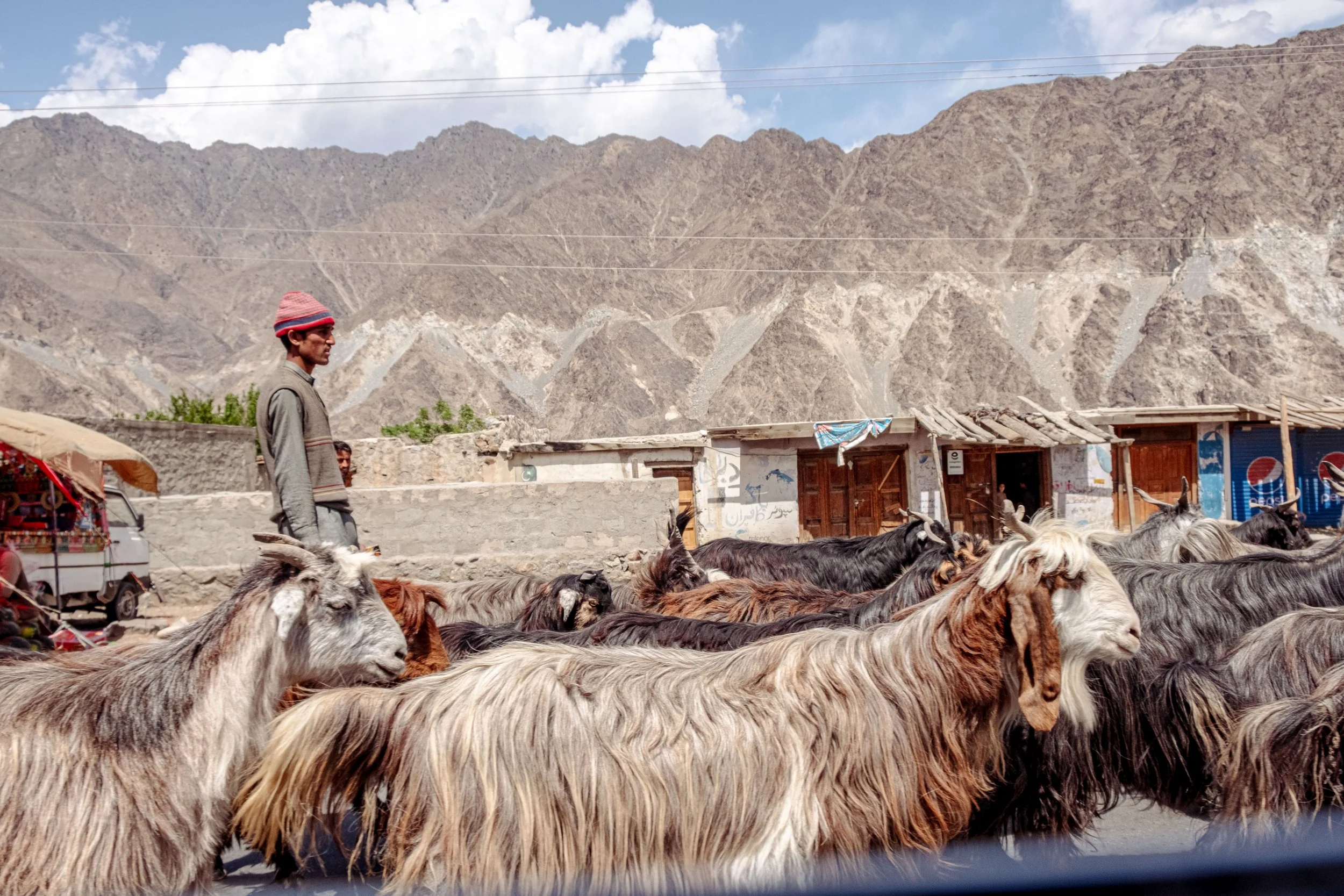
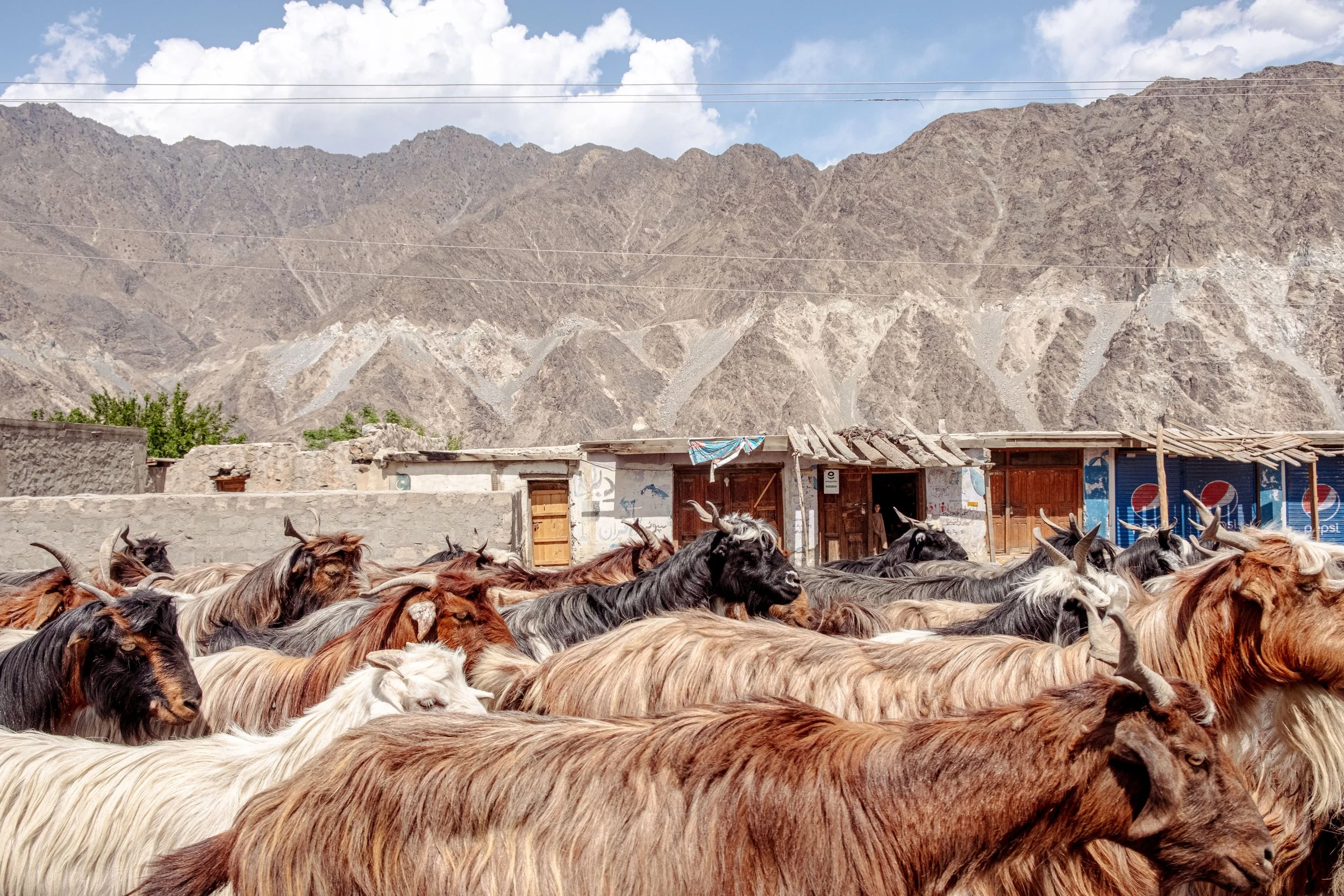
Around us the village carries on regardless. Men stand by the roadside, some in groups, some alone, watching the endless line of cars and painted trucks. Boys haul sacks bigger than themselves. Small circles of men stand arms crossed, guarding shops overflowing with goods. I keep my head out the window, shooting everything I can, resisting the urge to throw open the door and walk.
Crammed inside the sedan, windows down, exhaust filling the cabin, I notice him — an old man leaning on his stick between two parked cars, watching the road.
I shoot. Then his eyes find my lens.He holds my gaze, raises his hand to his mouth, and slowly shakes his head.I lower the camera. Roll up the window. Sink into my seat.
I don't shoot again for hours.
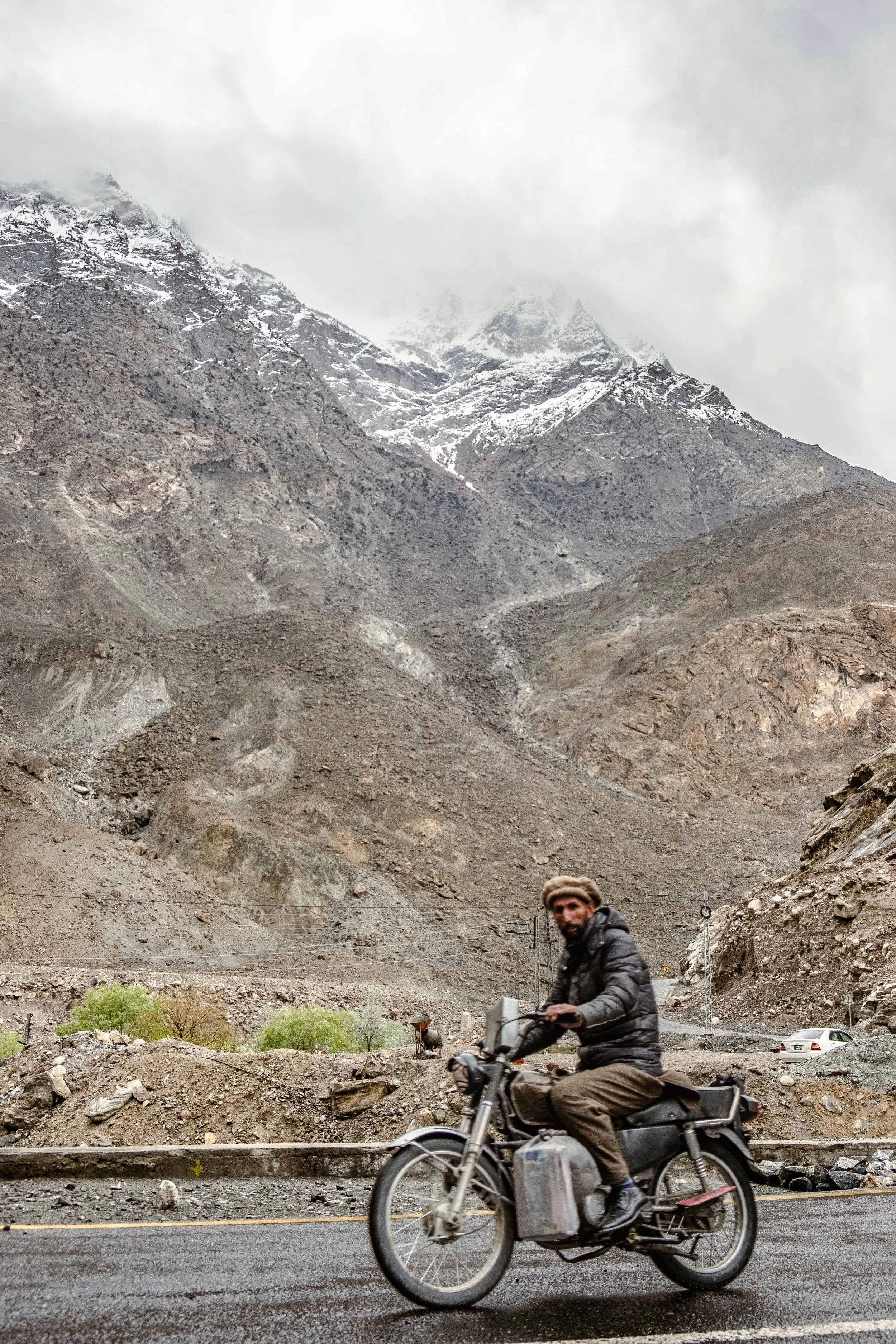
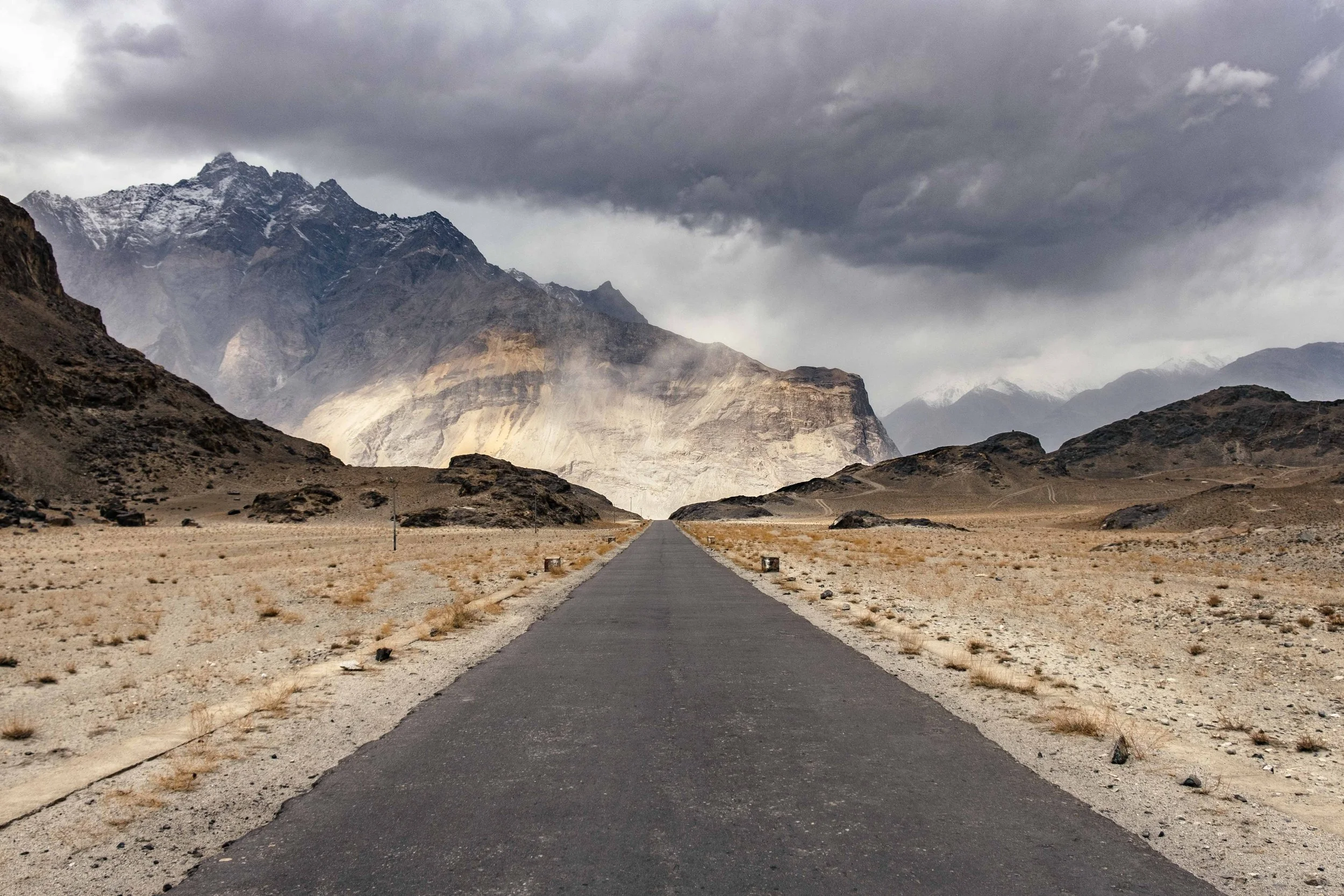
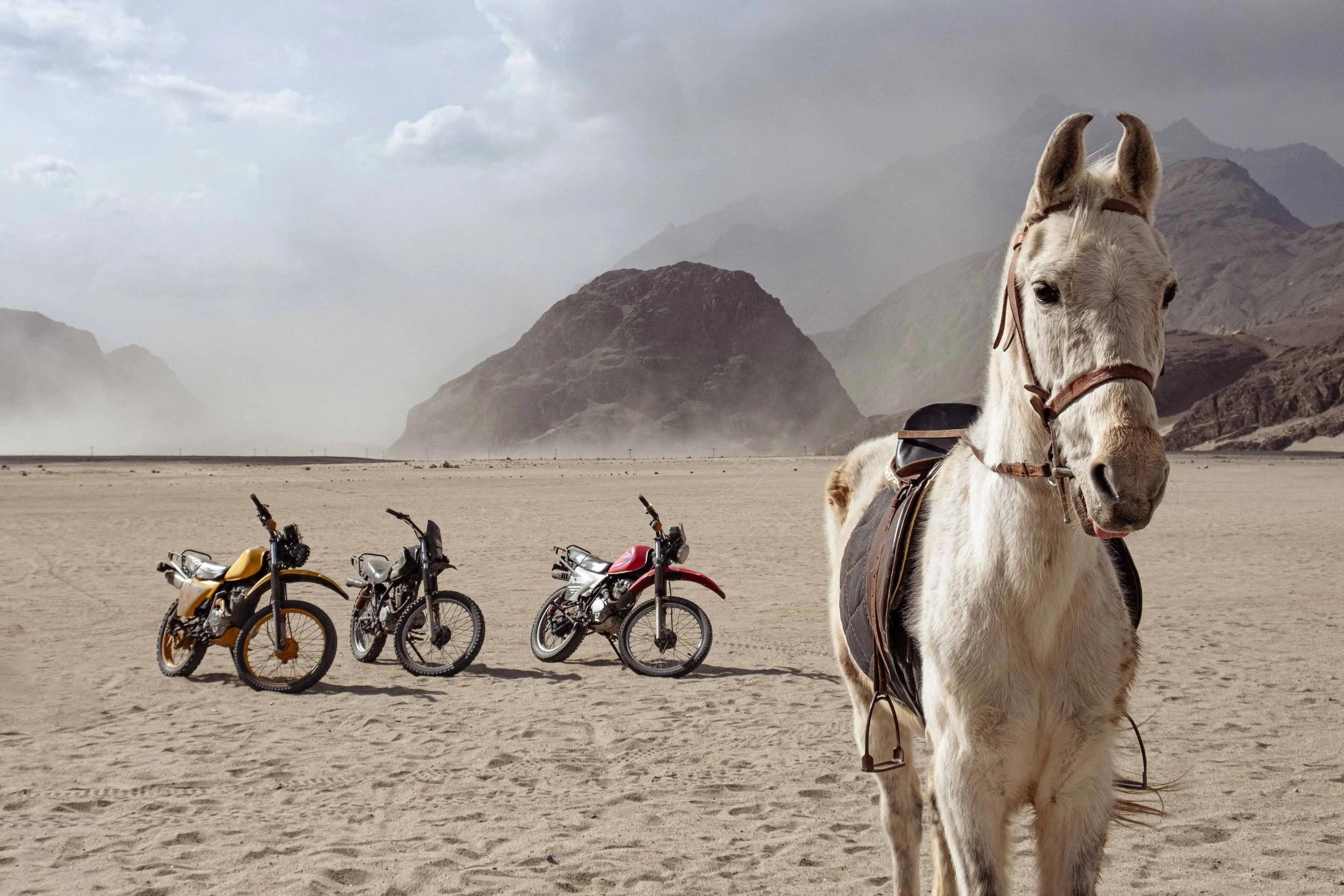
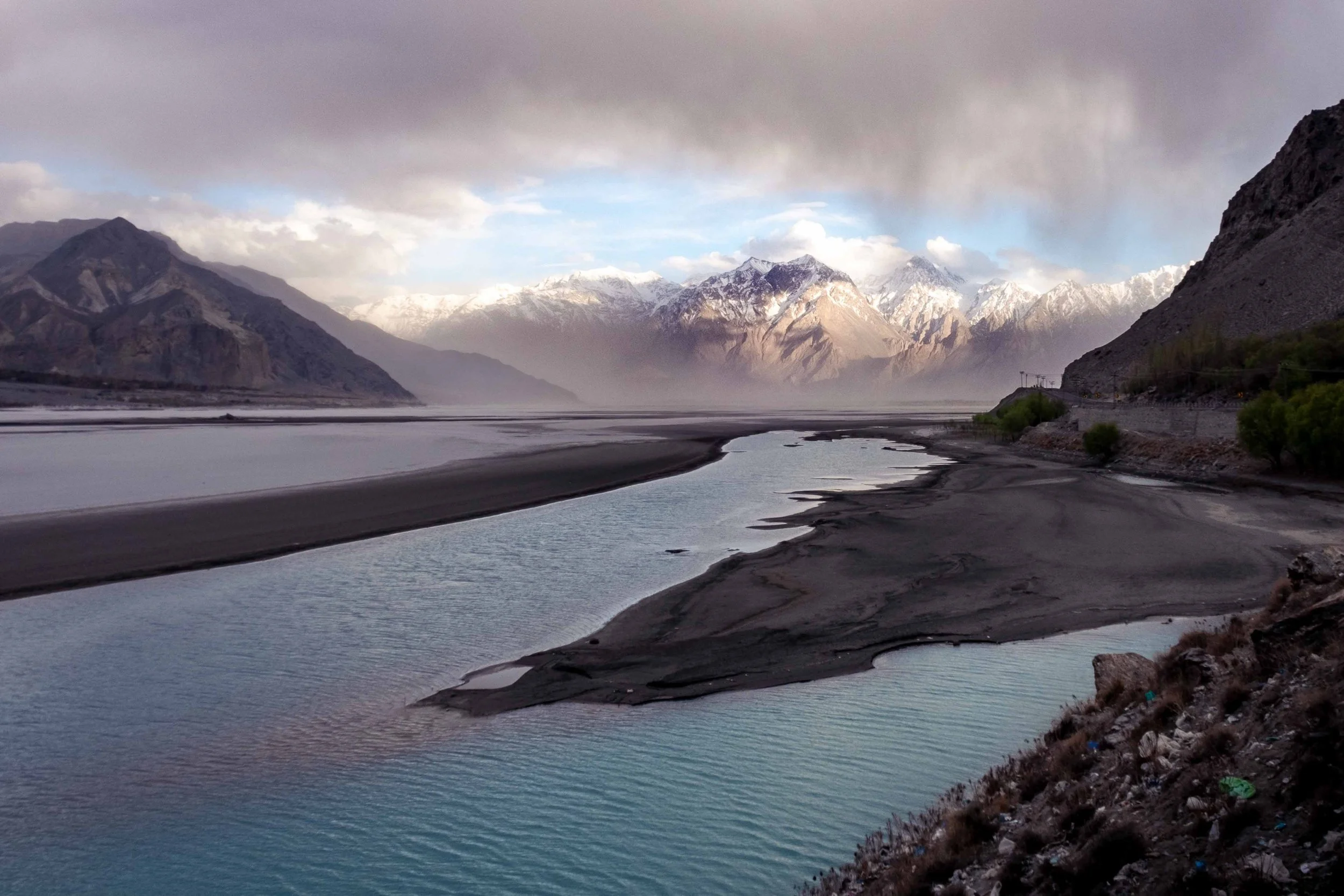
Skardu, 2,228mt
We arrive in Skardu at night, after days of travel.
Against the rule set by our driver, Mr. Gilani, we have been on the road for several hours past the sunset prayer, long after the sun has gone down. Once again, the darkness and silence around us make us feel lost in the middle of nowhere — only the rocks keep shining in the dark: not even a moonless night can hide their snow-covered peaks.
We begin to breathe the cold mountain air.
In the morning I discover that the electricity in our apartment is too weak: my camera batteries have not charged. I load a roll of film into my analog camera and we go out to explore.
Skardu takes us by surprise: it is a lively town, swarming with people going in and out of small improvised shops, motorbikes and pickup trucks running through the streets. Many young men ride three to a bike; they slow down to look at us, but nobody seems surprised or puzzled by my presence.
Walking along its dusty streets, brightly coloured murals appear everywhere — portraits of patriotic symbols and of climbers who succeeded in their mountaineering feats. This is the navel of the world for climbers: from here, expeditions set out for the base camps of K2 and Nanga Parbat.
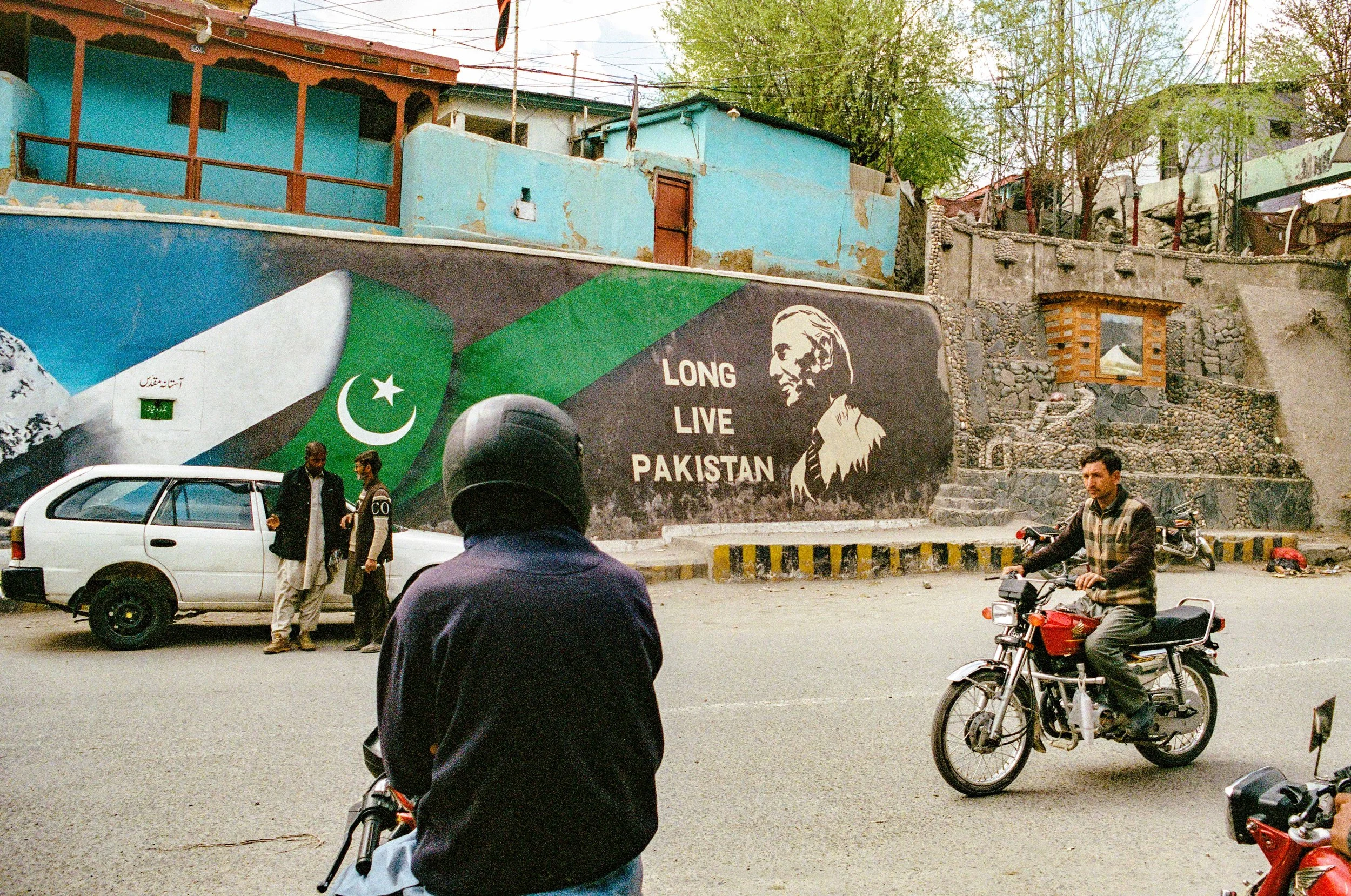
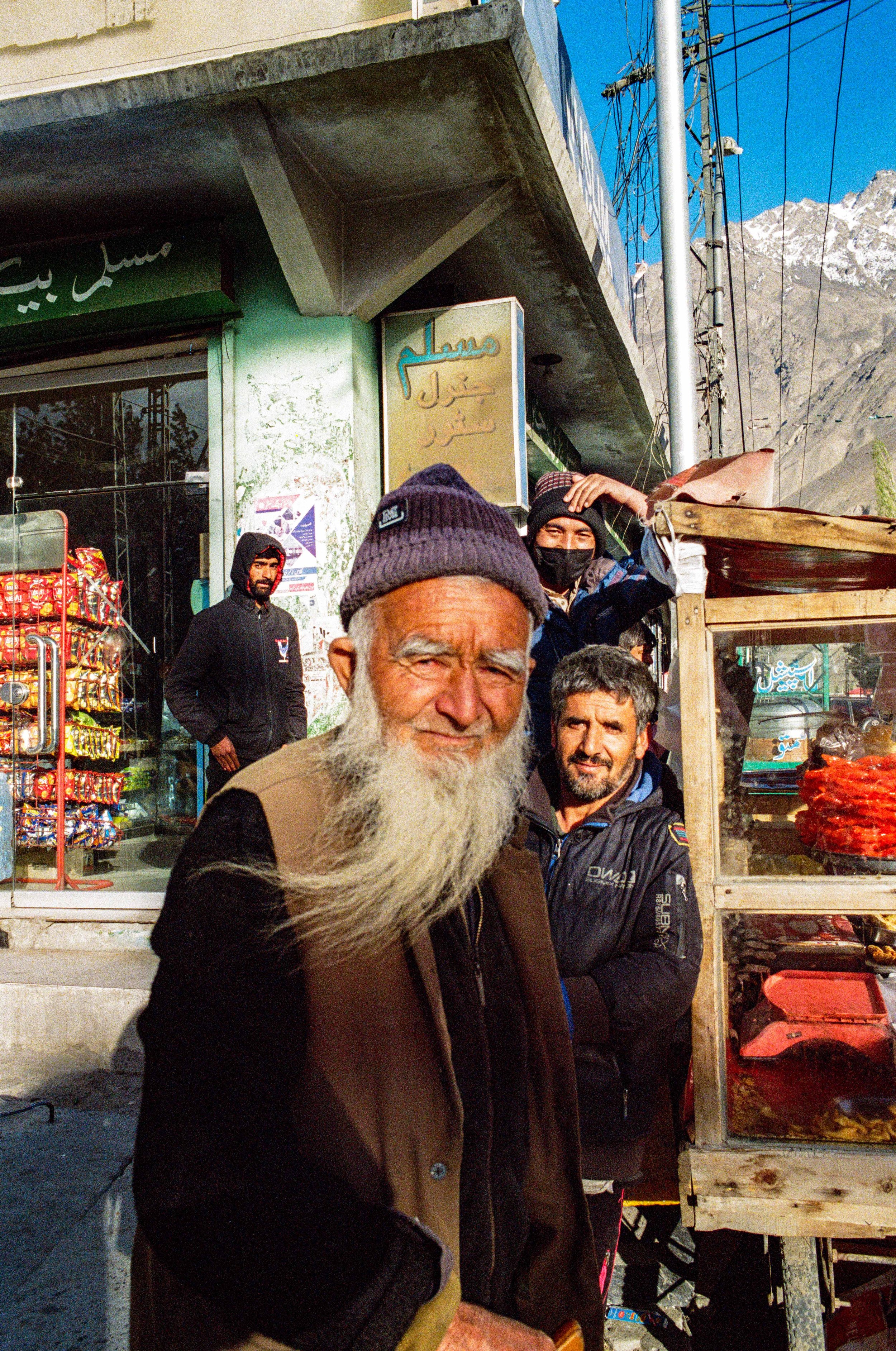
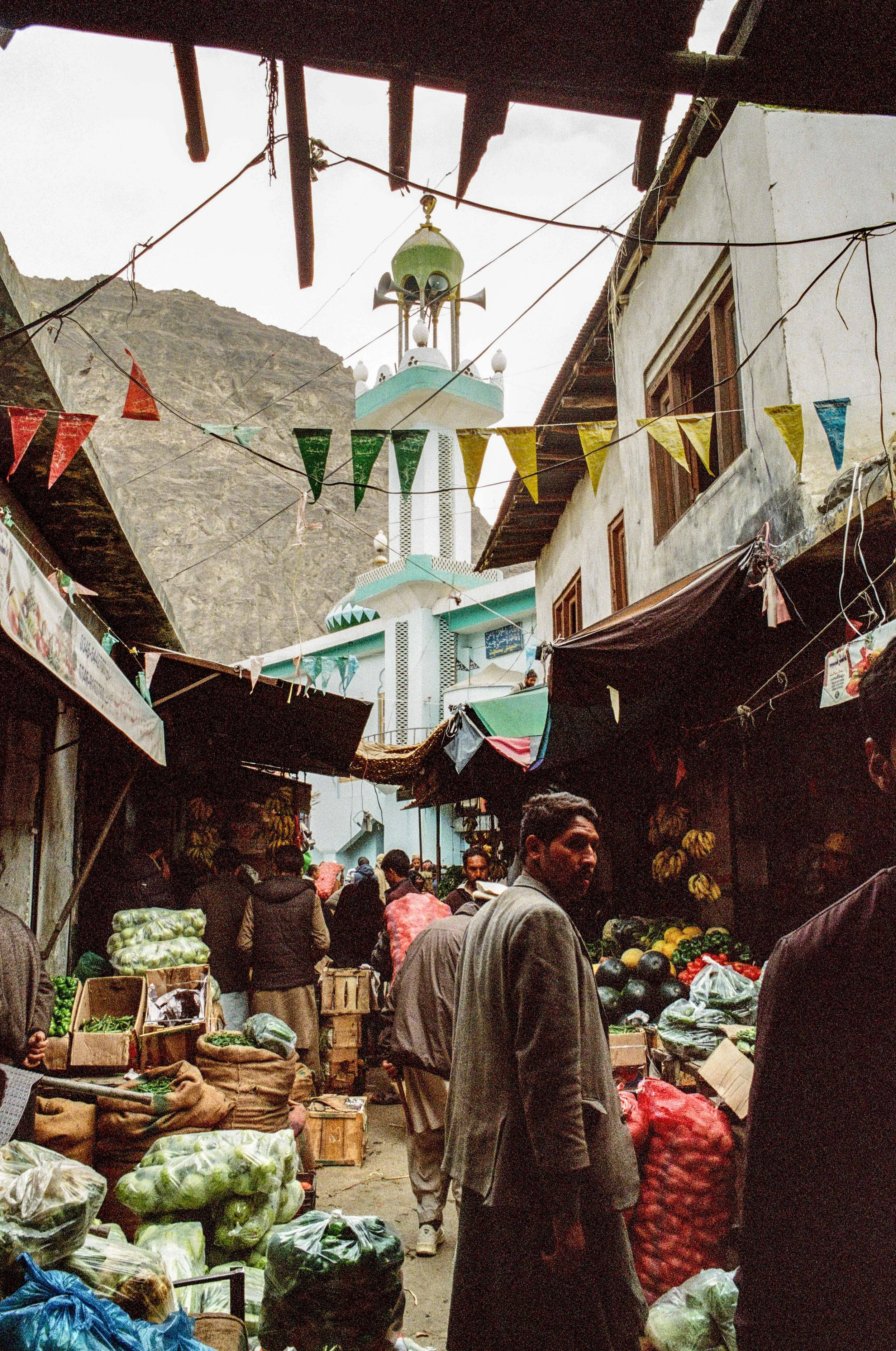
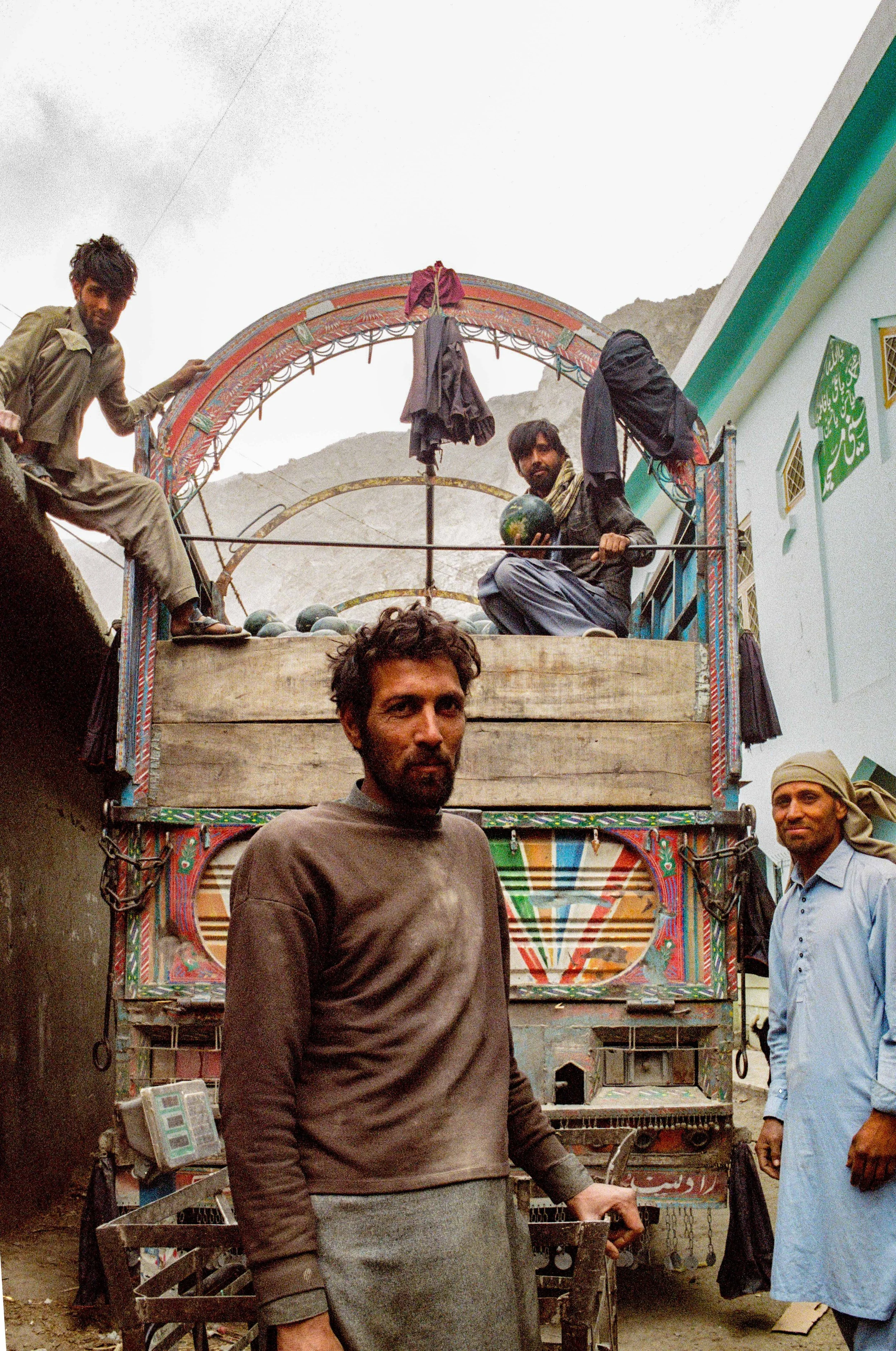
The market
We find the market: it is alive, teeming with people loading and unloading goods.
At the sight of my cameras they smile at me, and someone starts pointing out who I should photograph, or shows me the beauty of his products; others give me toothless grins and strike graceless poses — without leaving me the time to focus, they have already changed position.
As I take these photos, behind me the whole market is amused and stirred up by this improvised set. The watermelon traders who were unloading their fruit have stopped, and watch their companion with curiosity from the top of the trucks.
A couple of them have in fact taken charge of the situation, pushing in front of my lens perhaps the shyest of them all — who ends up standing there, helpless, looking at me with shining eyes, happy but uncertain.
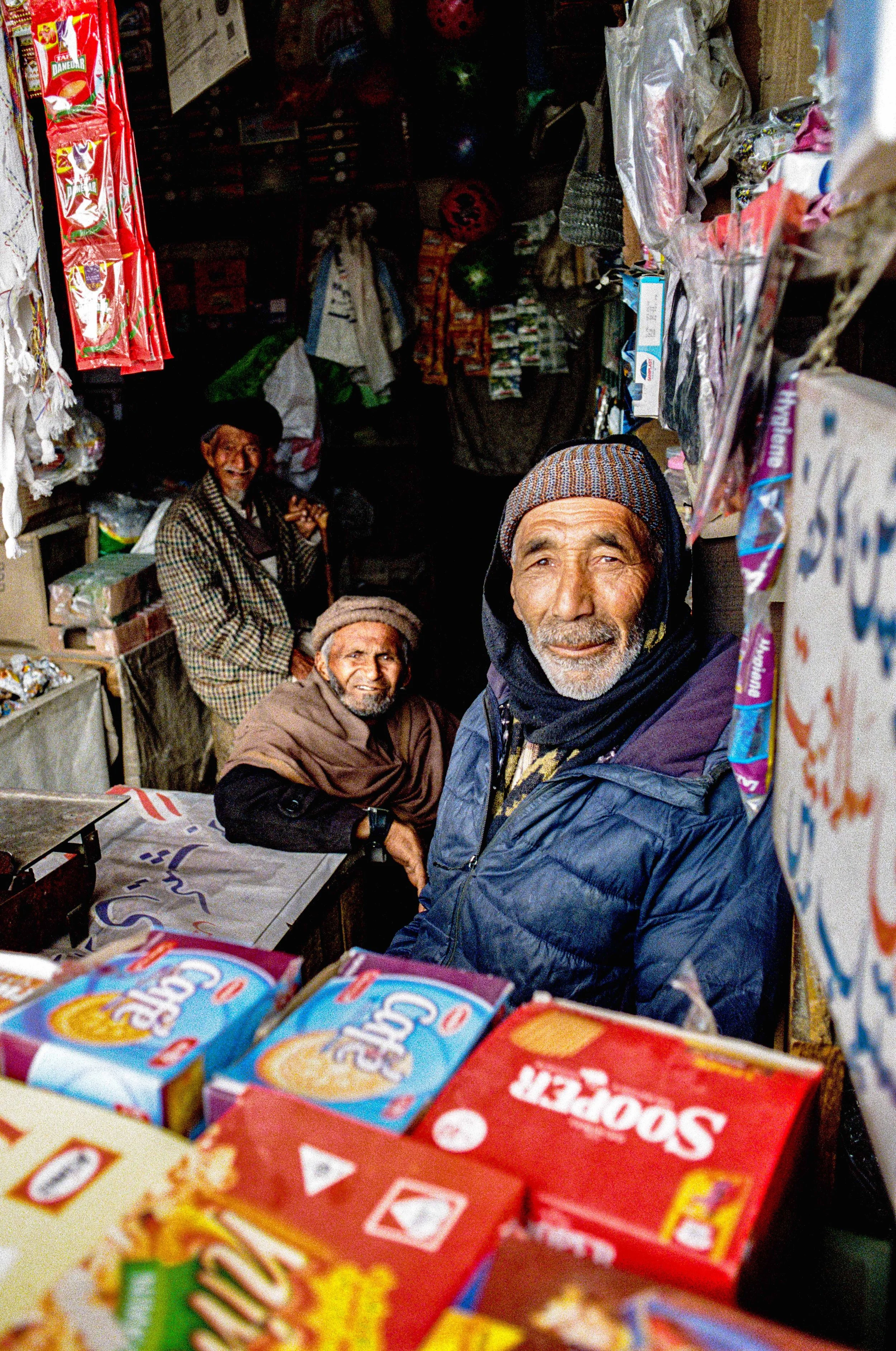
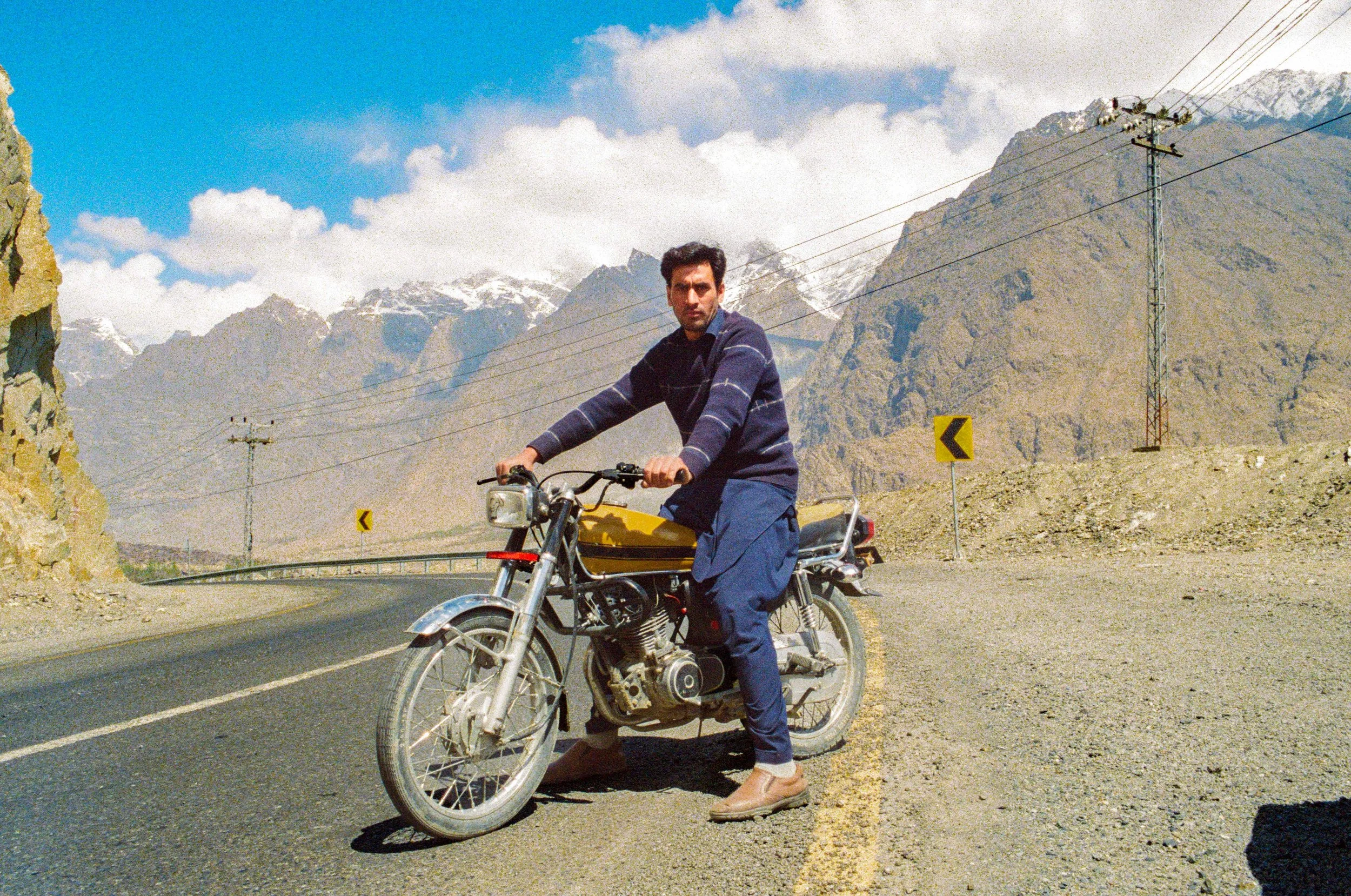
The motorcycle man.
"Mr. Gilani, please stop here now!" I shout to our driver.
We had just left Skardu behind when I see him: a young man standing next to a yellow motorbike, still, in a lay-by at the edge of the road.
It is morning, and we have been back on the road for about twenty minutes. Mr. Gilani has not yet lost his patience — he doesn't argue and pulls over sharply next to the bike. I jump out of the car while he, already astride the motorbike, is about to hit the gas.
I raise my hand and point to my camera. Inside, I fear I might unsettle him, scare him off; I pray he won't say no.
Surprised but calm, he looks at me and nods.
I can photograph him.
His pose is as elegant as that of a Hollywood actor from another era. I hold my breath and shoot. I wind the film two times.
Then I thank him, bringing my right hand to my heart, as people do in these parts. He says something, and they translate for me: he is thanking me from the heart — he is honoured.
I notice how much his face has softened since he first saw me step out of the car. His eyes, wary and almost threatening at first, are now gentle and grateful. Who knows what went through his mind. He hints at a smile, trying to return mine, but I can sense how unnatural it is for him to pull those cheekbones on such a serious face.
Then he revs the engine and speeds off towards Skardu.
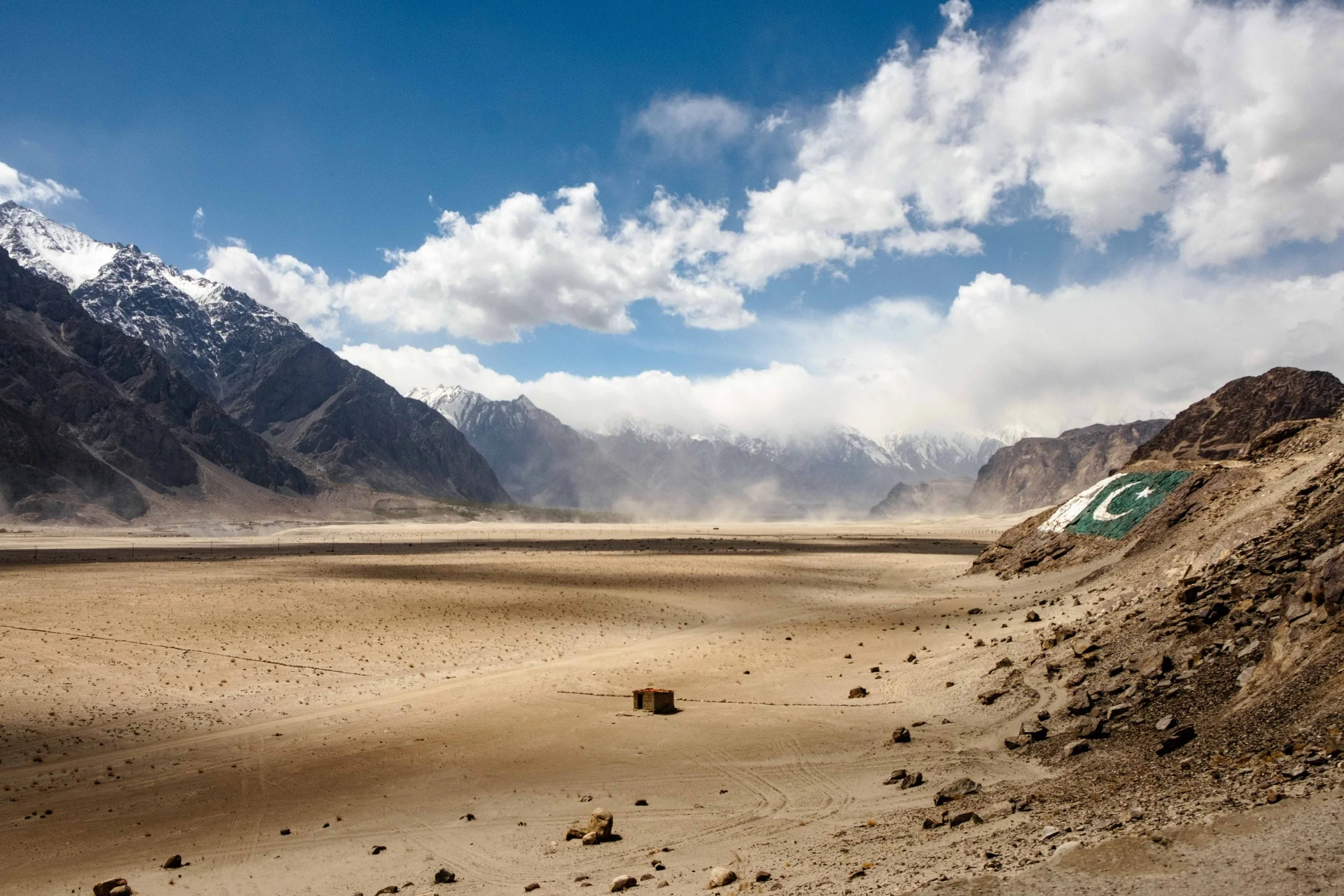
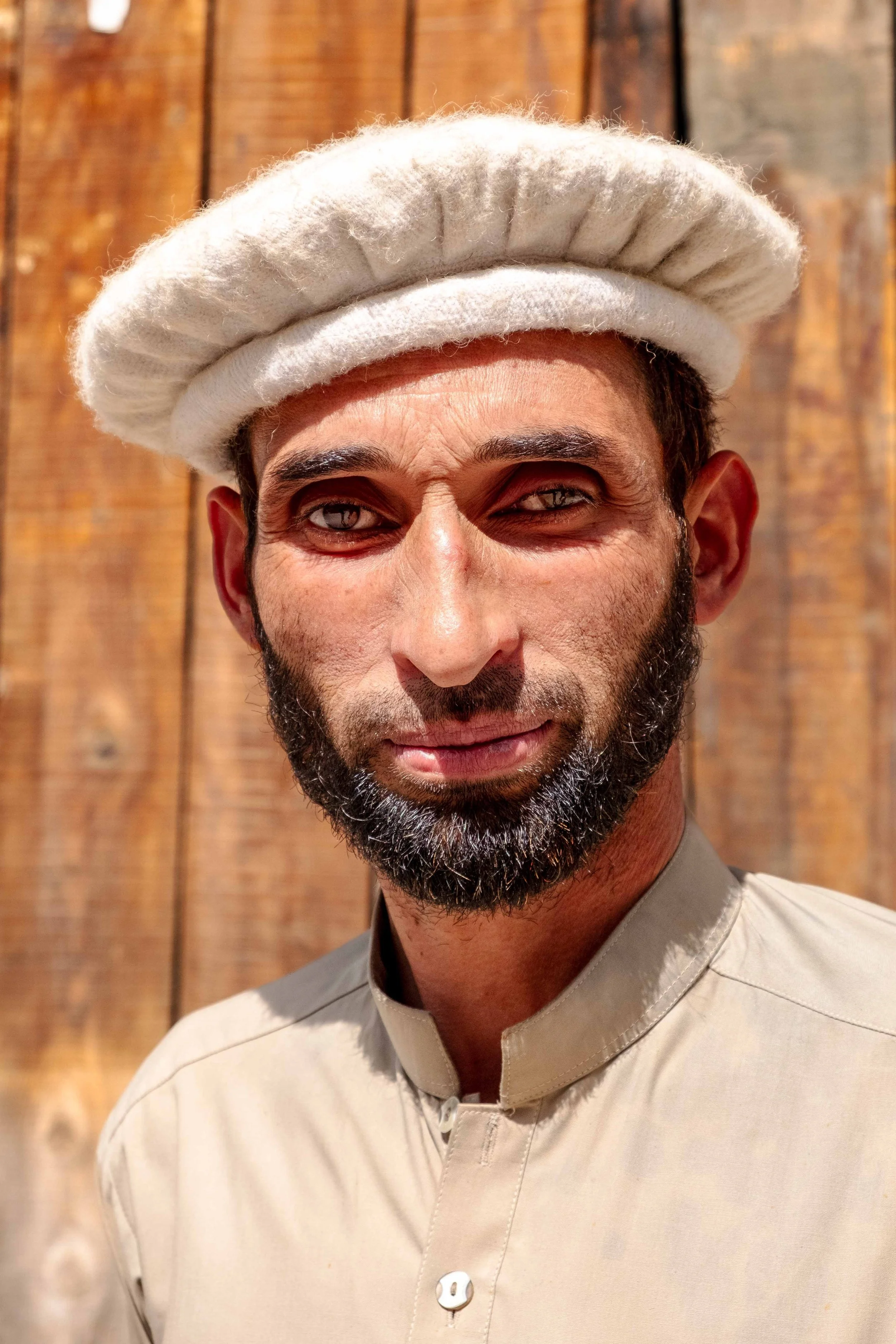
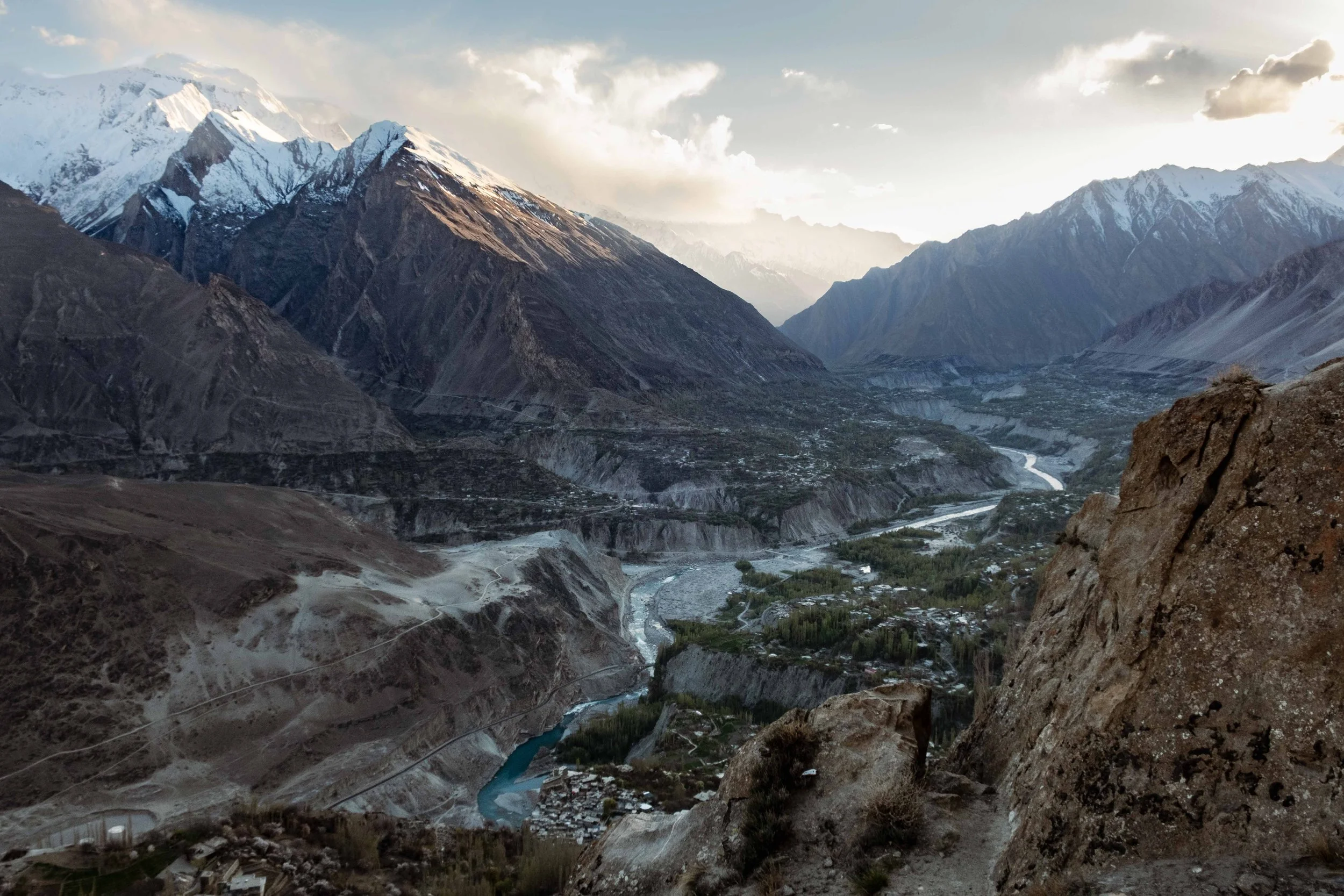
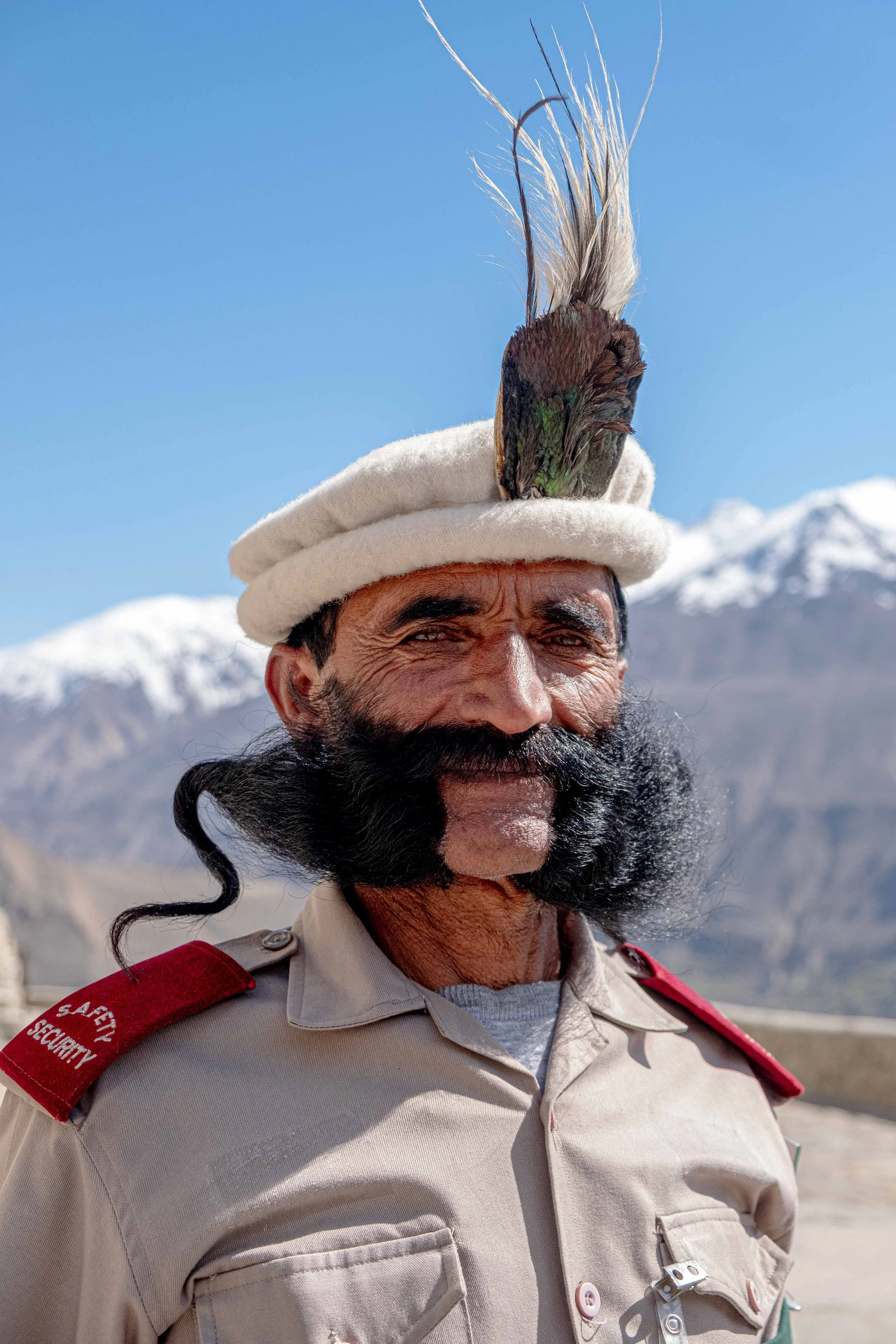
Karimabad, Hunza Valley, 2,438mt
The Lost Paradise of Shangri-La
When our guide Hazeeb turns to look at us from the passenger seat, his eyes are gleaming:
"Guys, finally we are driving in the Hunza Valley! Alma, you can do whatever you want here!"
Hunza is a far more modern land than the rest of Pakistan — a religious parenthesis where the majority of the population is Ismaili. Ismailism is a branch of Shia Islam marked by a progressive interpretation, with a strong emphasis on education, social justice and peaceful coexistence.
For centuries this valley was a crucial crossroads along the Silk Road, where traders and pilgrims stopped, drawn by its beauty and its resources. Many legends surround this place, telling of a mythical realm hidden among the mountains that has always attracted travellers and scholars. The most famous is the one linking Hunza to the lost paradise of Shangri-La, described in James Hilton's novel Lost Horizon. The Hunza Valley was said to be a land of eternal youth and health, where people lived beyond a hundred years thanks to the purity of its water and air. These legends make the valley all the more mysterious and alluring — a place rich in history and mythology.
Khunjerab Pass, 4,693 mt
We have reached the border.
We came face to face with the Chinese frontier and stood there, looking at that colossal concrete gateway — a clear echo of the Forbidden City, crowned with glittering golden Chinese characters.
I had never asked myself what the border between Pakistan and China might look like, and the sight of that massive gate in the middle of a white expanse, lost in the void, made me smile: it was as if that monumental construction claimed to inspire awe, to stand as an impassable barrier — up there, among all those gigantic peaks that made it look instead like a small tower, stranded in the blinding white of the snow.
Guarding the end of Pakistani soil, only one man with an old Kalashnikov slung over his shoulder, happy to see someone he could show off his weapon to. On the Chinese side, not even a moving shadow: it looked deserted.
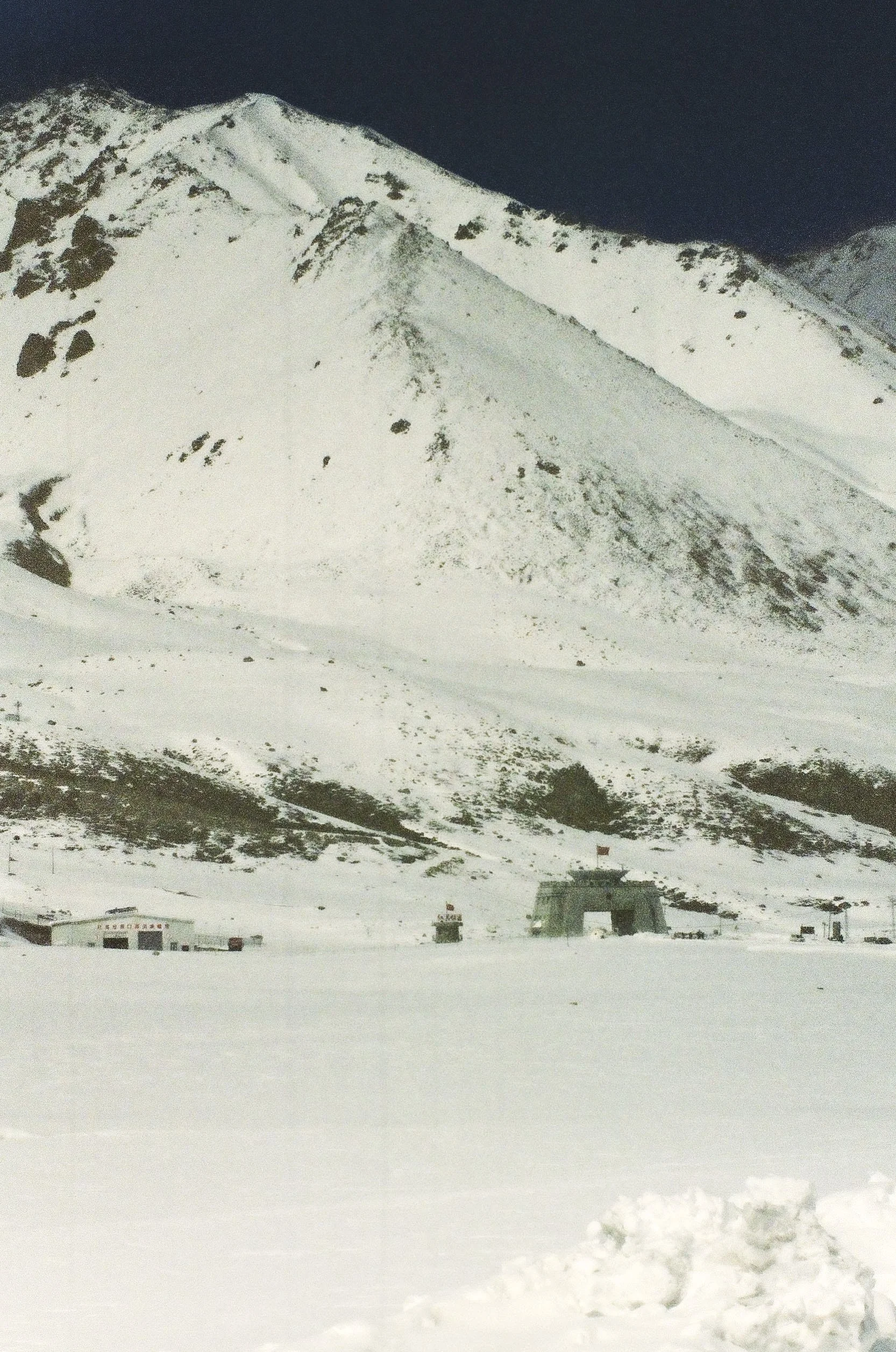
This is the only photograph I managed to develop that is even barely visible. The roll I shot up there kept a secret from me until the day I developed it: the film turned out to be completely altered — only in the frames taken there, at over 4,600 metres. A colleague of mine suggested the presence of magnetic fields in the area. As intriguing and mysterious as that explanation may be, I prefer to see it as a small joke played by fate.
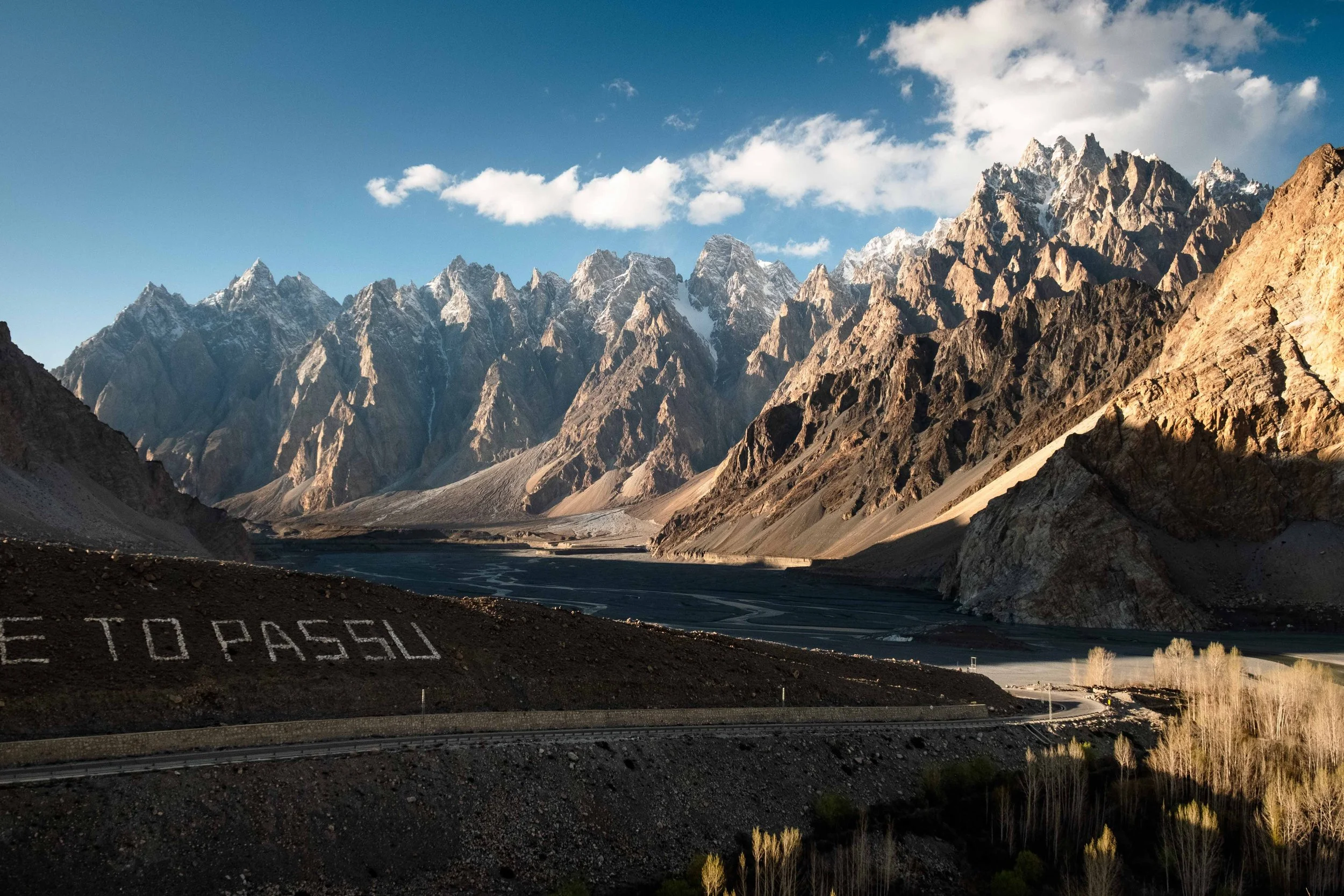
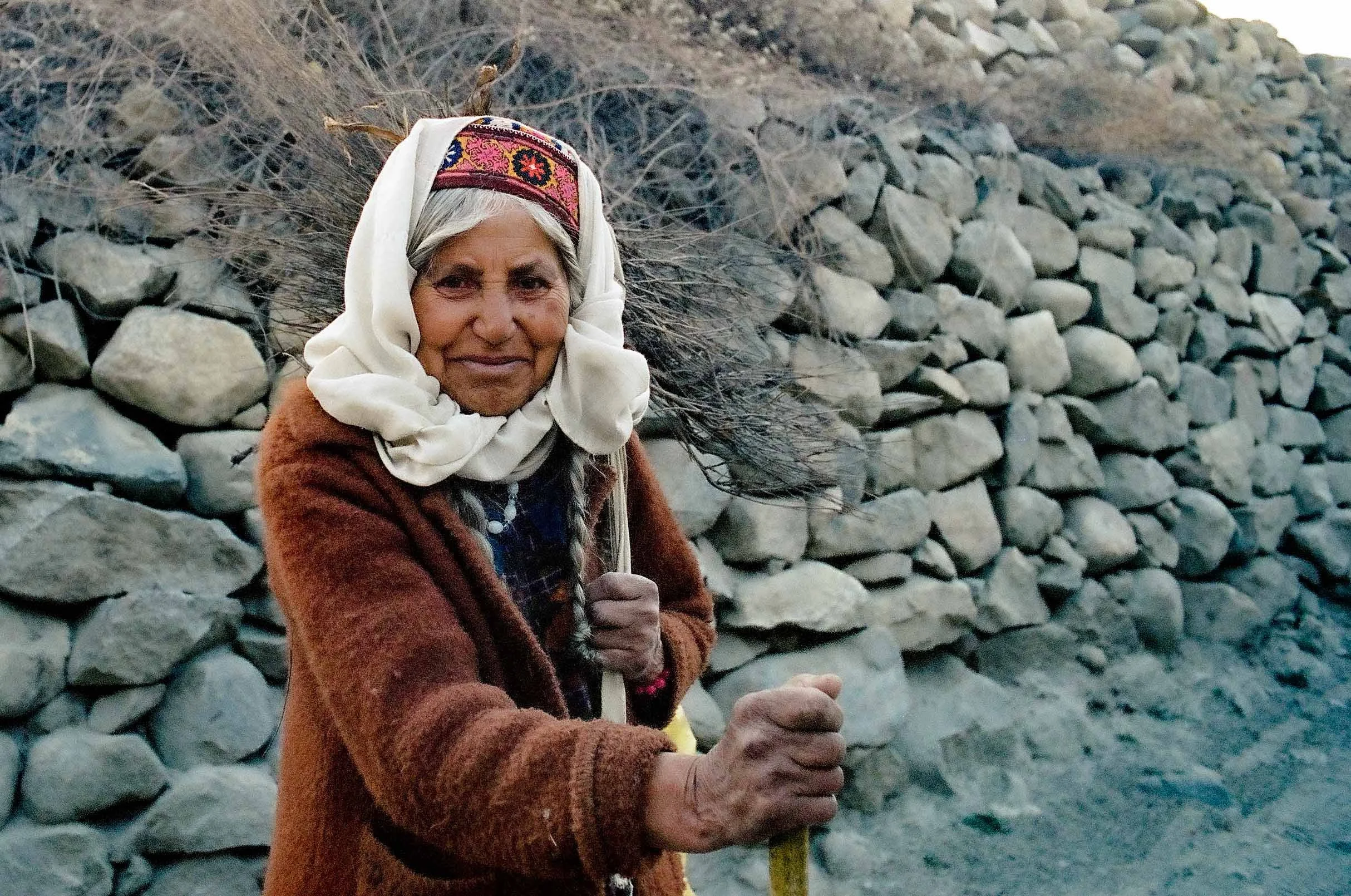
The woman.
Trying to keep up with my companions, who are climbing down through the rocks towards the bridge, I walk with my eyes on my feet, focused on not losing my balance — when I almost bump into her, slowly making her way up in the opposite direction.
I freeze, disoriented, apologise in Italian, then take in the scene: in front of me stands a woman with a bundle of firewood on her back, climbing the hill. We look at each other for a long moment. She seems surprised too.
She strikes me as extremely elegant — I am captivated by her braided hair and her colourful headdress. She doesn't look away either, but studies me as if rediscovering how much the face of an old friend has changed.
It is as if we recognised each other.
We exchange a smile.
Then I raise my camera and point to my face with my right hand: I go for it — I find her beautiful, I want to photograph her.
She nods, and without changing her pose she waits for me to take the picture.
I was not ready for this unexpected encounter. I shoot twice, incredulous at having a female face in front of me. Who knows if anything will come out — the light is low, it's sunset, and we're in a patch of shadow, no less!
Then I bring my hand to my heart to say goodbye; she does the same and continues uphill, while I watch her, still incredulous, carrying that load of wood on her back.
I turn around and see my companions down in the valley, in the distance — they have already reached the Passu suspension bridge.
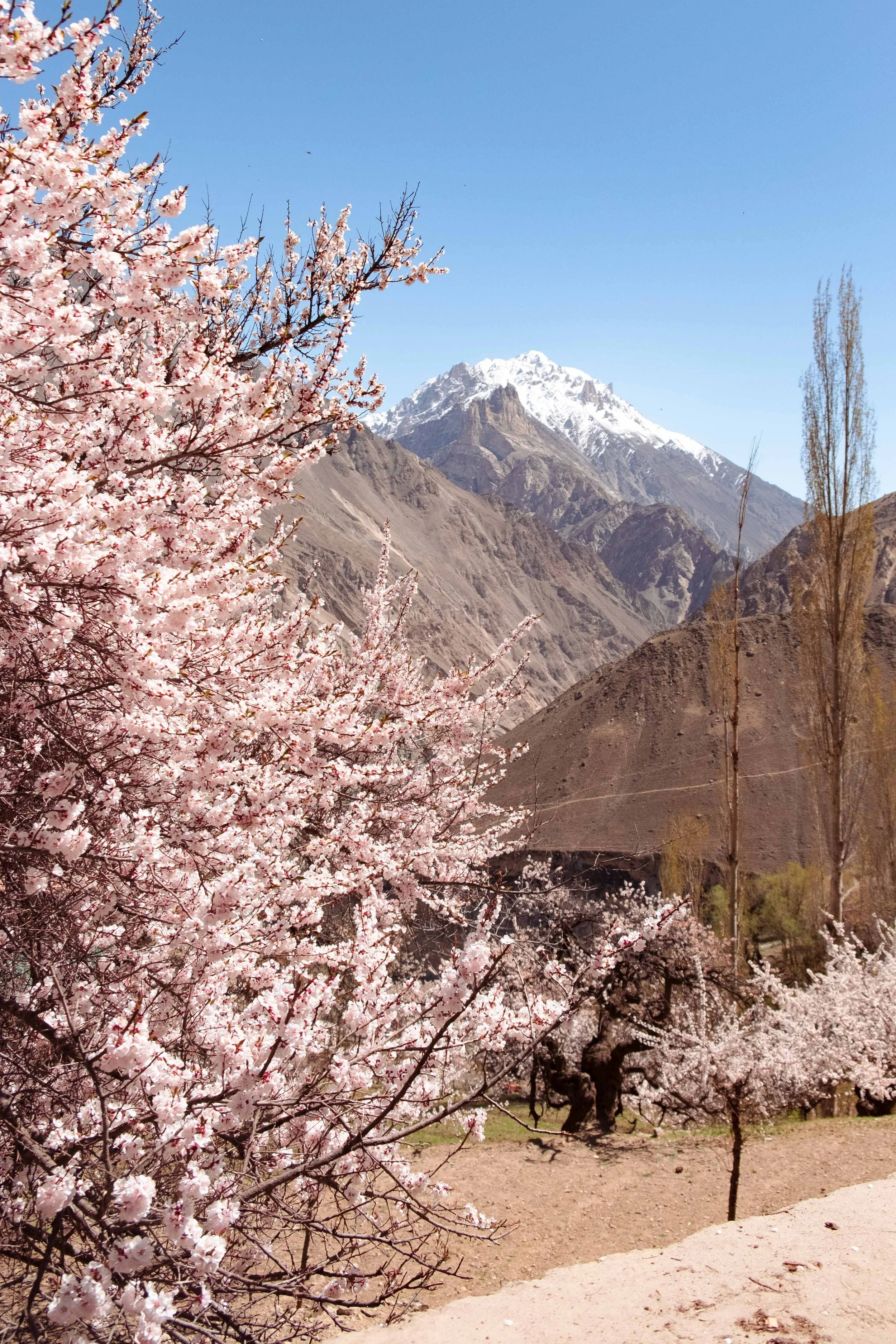
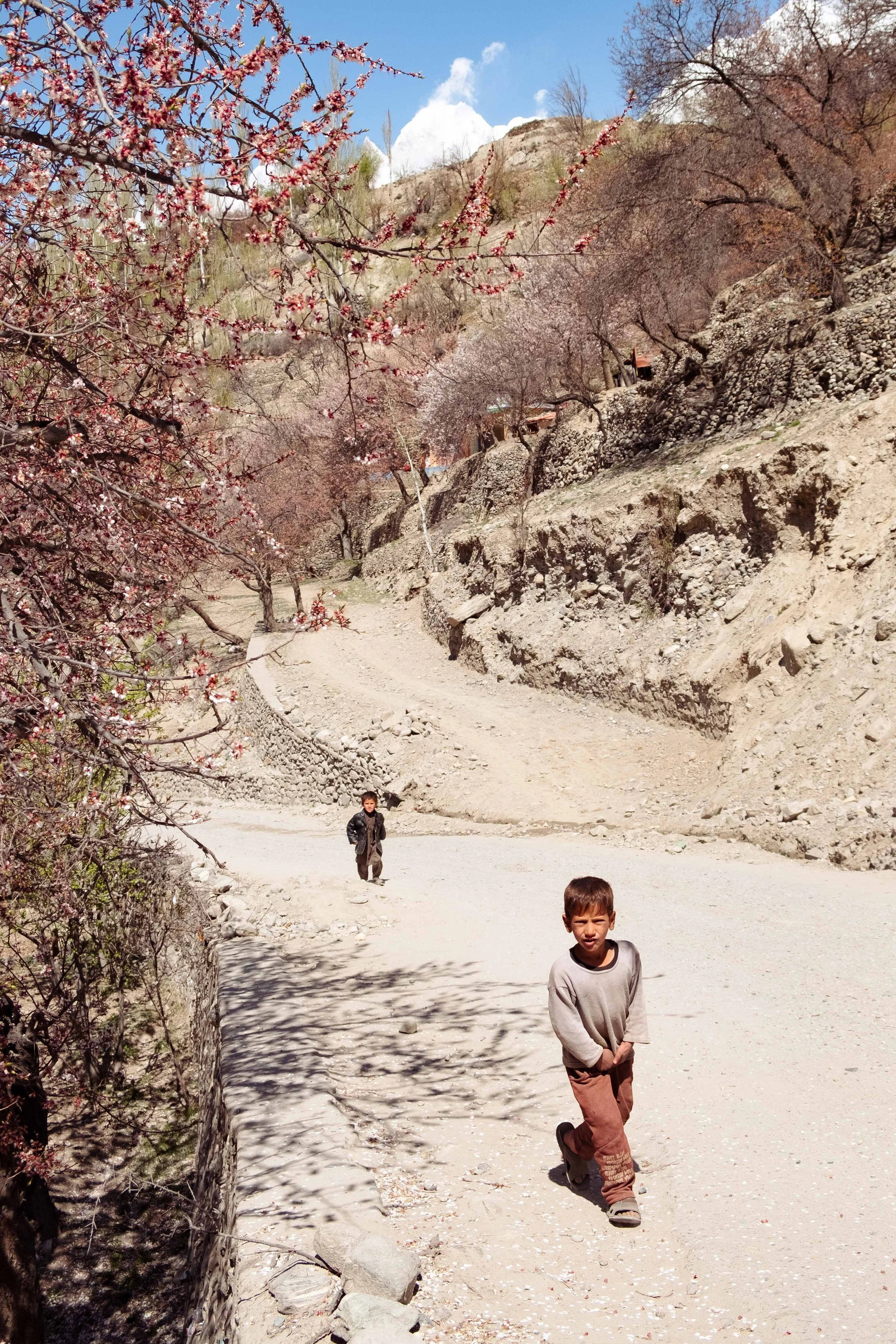
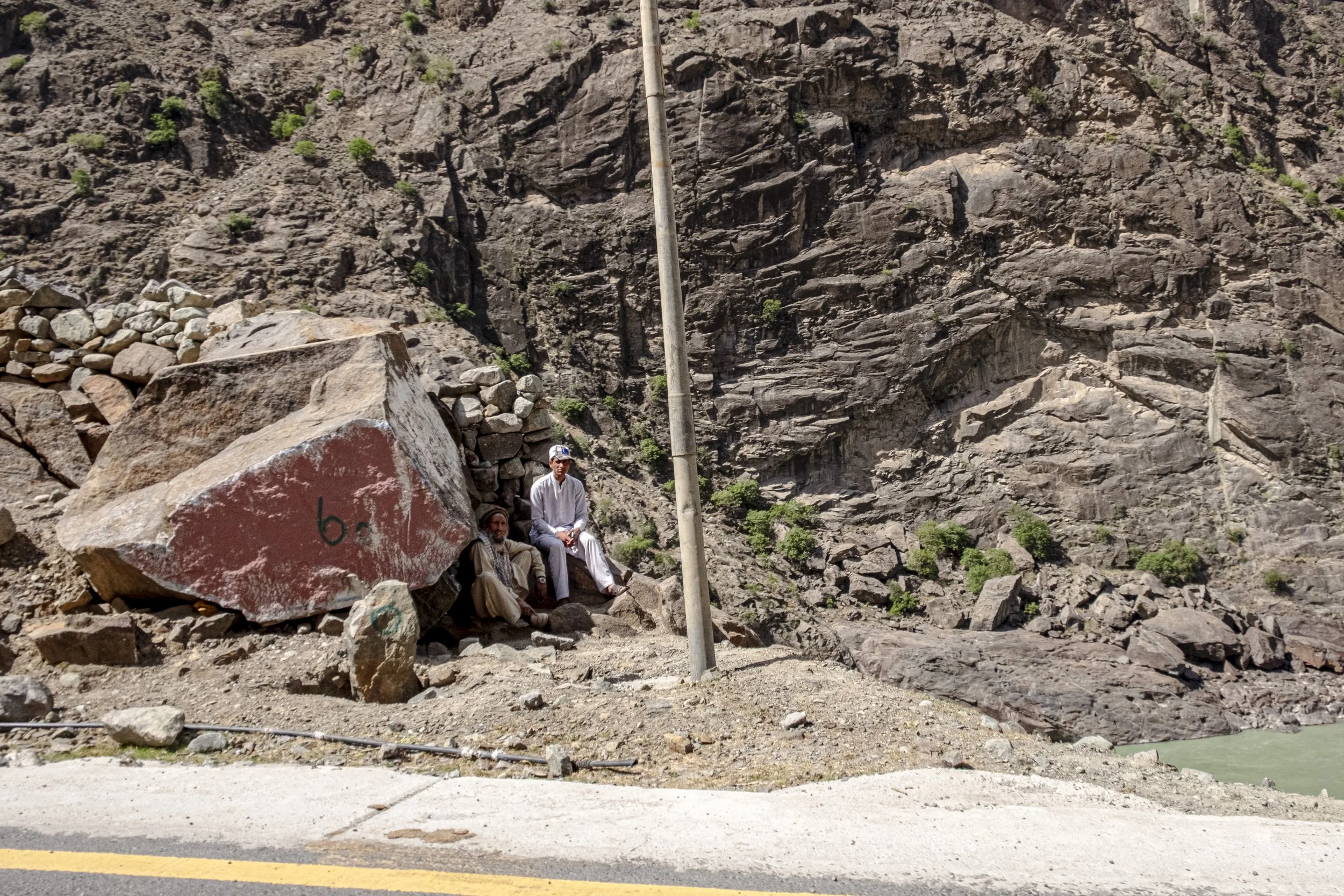
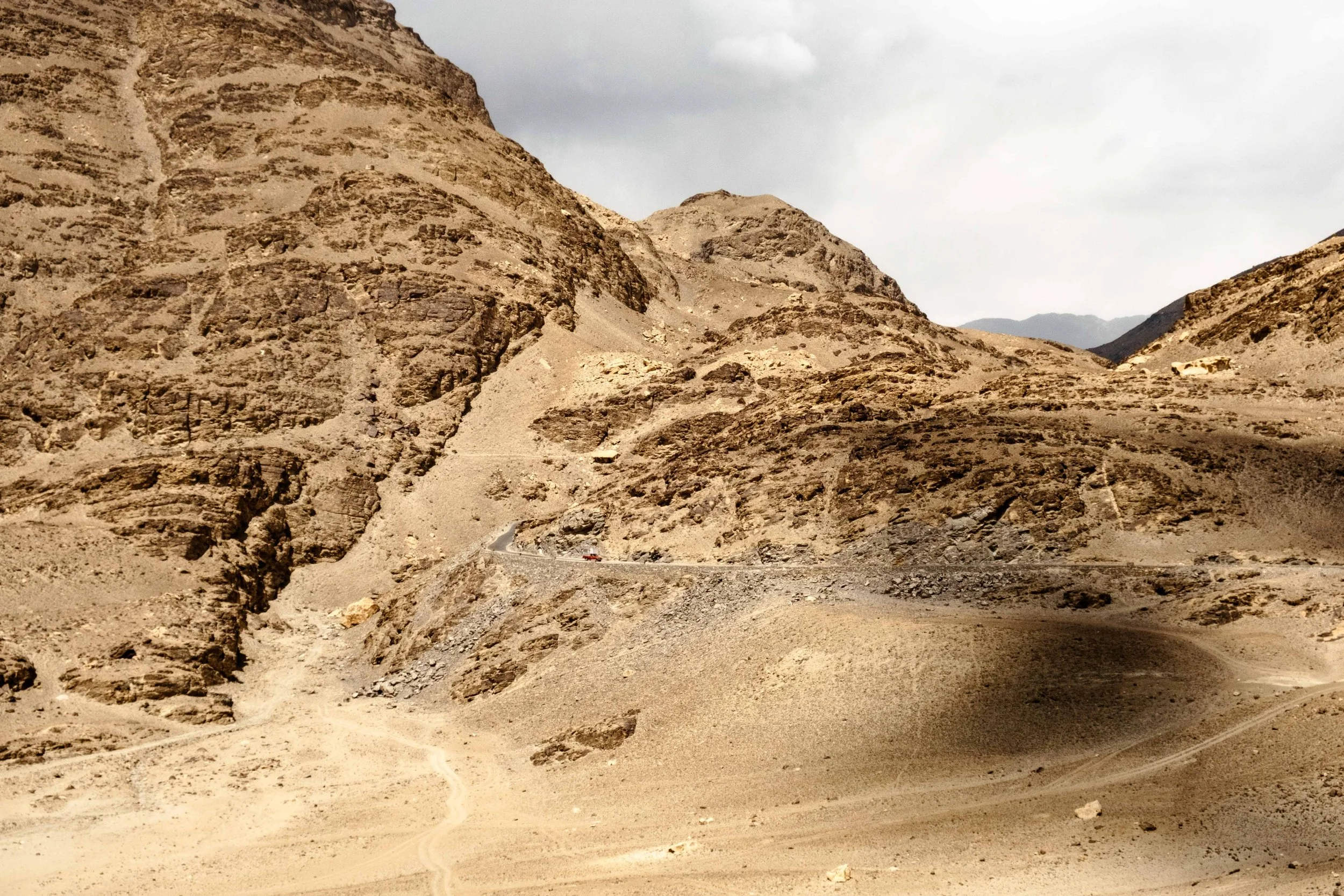
The eyes in the rocks. For hours, nothing gives away a sign of life. I feel swallowed by the center of the world, a desert of mountains that bends the horizon and disorients.
We drive on, watching for stones fallen from the cliffs, until we stop in front of a massive boulder blocking the road. A few drivers have climbed down from their trucks, trying to shift it aside. On the other side, the road drops into a sheer gorge.
Twelfth day of travel. Hundreds of kilometers of landscapes that start to look alike — and still I can't keep my head in the car.
We're moving too fast to focus on anything at the roadside, but something catches my eye. I set the shutter speed and shoot blind.
Only that night, reviewing the photos before collapsing after a hurried meal, do I see them: two men, hidden in the shade of the boulders to escape the blinding sun, watching the road and whoever passes.
We were never alone. Not even in the desert. As if the rocks themselves had eyes.
Islamabad, return
Hotel room, last night in Pakistan.
Each of us takes a room of our own, after weeks spent sharing every inch of space. I shower and let my body dry slowly in the warmth of the room — I've kept it covered for weeks, and now I feel almost naked walking around with bare arms.
I close my eyes and see again that sea of rocks and men I've been immersed in for days.
She comes back sharply — the woman I met on the path at Passu. Her eyes meeting mine revealed how much I had missed the company of another woman — how little I had learned of their way of moving, of dressing, of being in the world.
My mind drifts back two nights earlier, to a hotel in Muzaffarabad. Our Karakoram itinerary finished, we had accepted Hazeeb's invitation to show us his city, in Kashmir. Sitting with them over chai, I listen to a man telling me, with pride, how free his wife is: "I let her get her driving licence... but I don't let her drive. And she still has to look after the house." My travel companion D., ever diplomatic, asks how daily roles are usually divided. "Women think of the children and the elderly parents. They cook at home, we cook in the restaurants... I don't judge. If I came to your country, I'd respect how you dress and behave, just as you do here." I listen, composed. I smile at him. I sigh. Inside, my tongue rebels against the invisible chain I've placed on it.
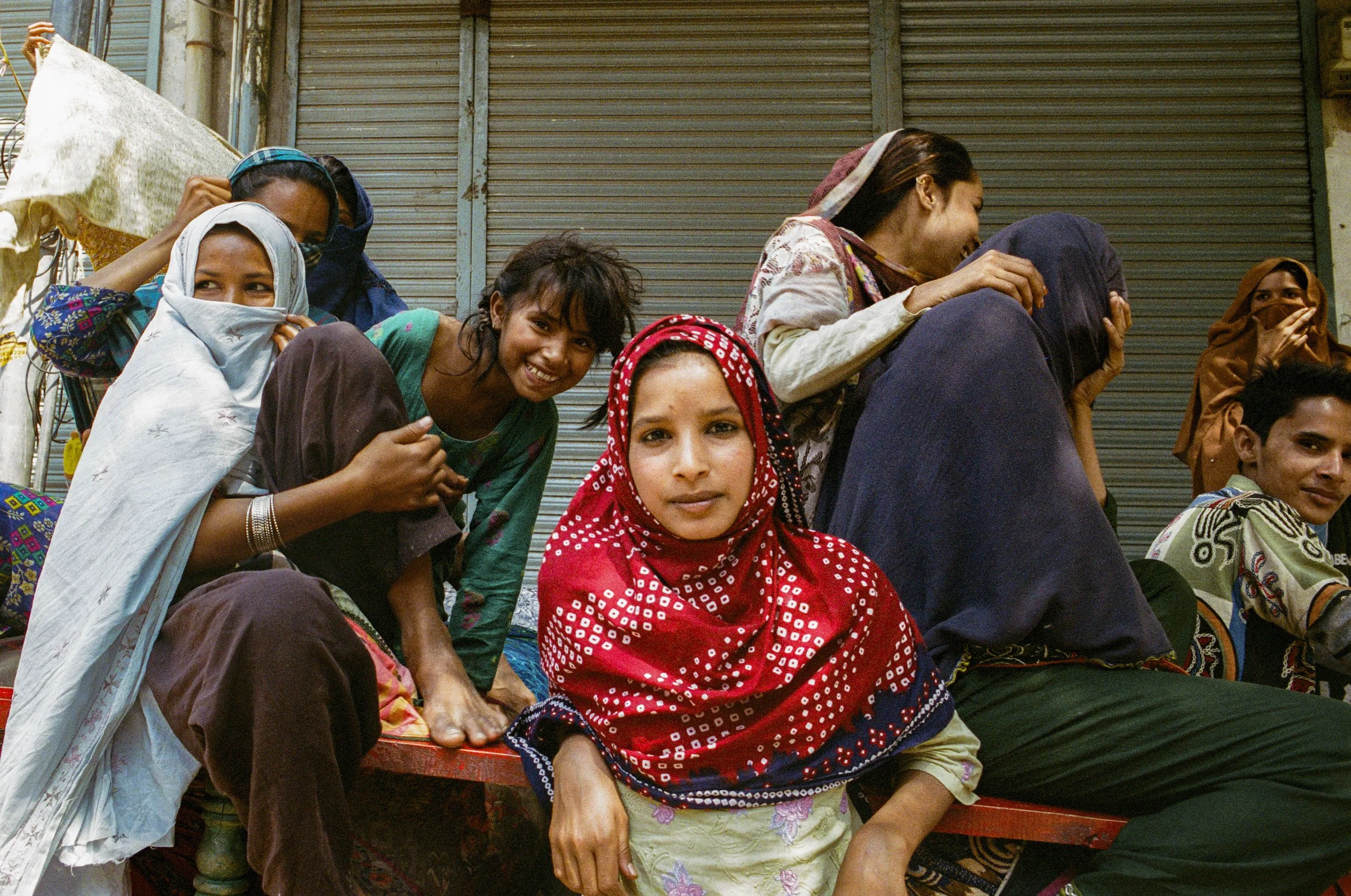
I look back through a video S. shot in the first days in Lahore: me, photographing a group of sisters in the street. Only now do I notice, at the edge of the frame, their older brother watching over them — his eyes fixed on my lens, silently giving his consent for them to pose, for me to photograph them.
I go looking for that photograph among the thousands I took, and find it: the confirmation of what the video had just shown me.
I wish I had gone deeper into their lives.
I didn't.
For a long time I thought I simply hadn't managed to.
Then I understood that, in truth, I hadn't wanted to: to impose myself as a direct interlocutor would have meant unsettling local equilibria to make room for my own values — values shaped by the West.
It wasn't silence out of relativism. There, I was a photographer, a guest, a foreigner — I had no right to intervene in the lives of those I was photographing. My judgment hasn't changed: it remains a respect that watches over individual freedoms, one that makes no exceptions for gender discrimination, whatever customs may shelter it.
-